15 Nov

Very Strong Employment Report For October by Dr Sherry Cooper

General

Posted by: Liz Fraser

Very Strong Employment Report For October
Today’s Labour Force Survey for October was surprisingly strong, boosting wage inflation to an eye-popping 5.6% year-over-year pace. While good news for the economy, this is terrible news for the inflation fight–just when the Bank of Canada eased its foot on the brakes. The two-year and five-year Government of Canada bond yields spiked on the news, calling into question the Bank of Canada’s decision last week to trim the rate hike to 50 bps rather than the 75 bps that was expected. While one month’s data is not enough to draw too fine a point, this does call into question the assumption that fourth-quarter growth will be substantially less than 1%.

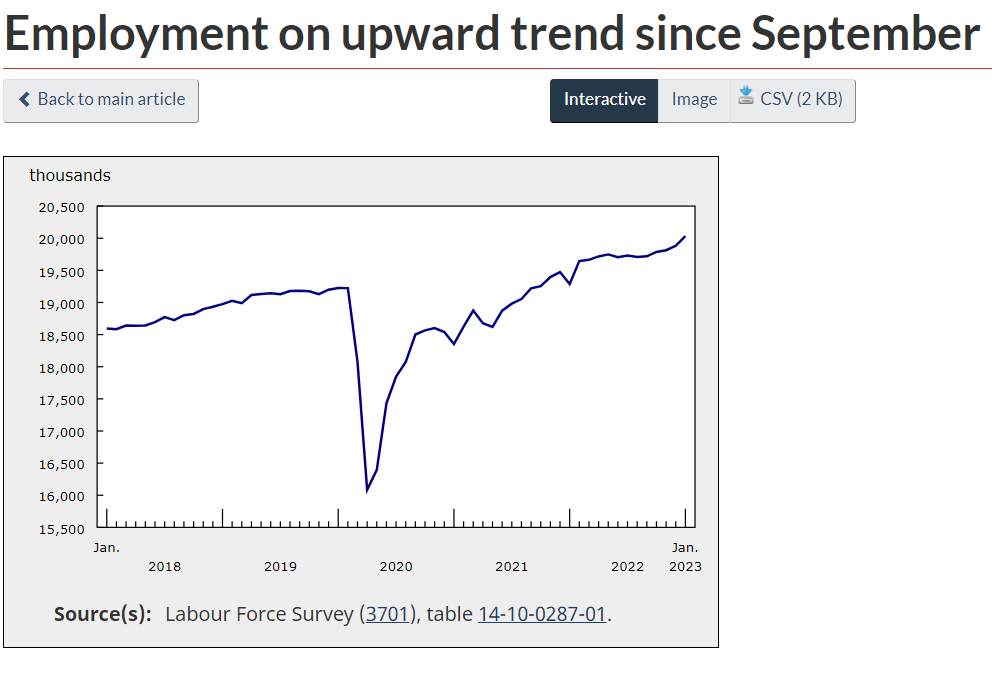
Following four months of declines or little change, employment rose by 108,000 (+0.6%) in October. This increase—widespread across industries, including manufacturing, construction, and accommodation and food services—brought employment back to a level on par with the most recent peak observed in May 2022. All of the gain in October was in full-time work, another indicator of economic strength. This was the first gain among private sector employees since March when the Bank of Canada began hiking interest rates.

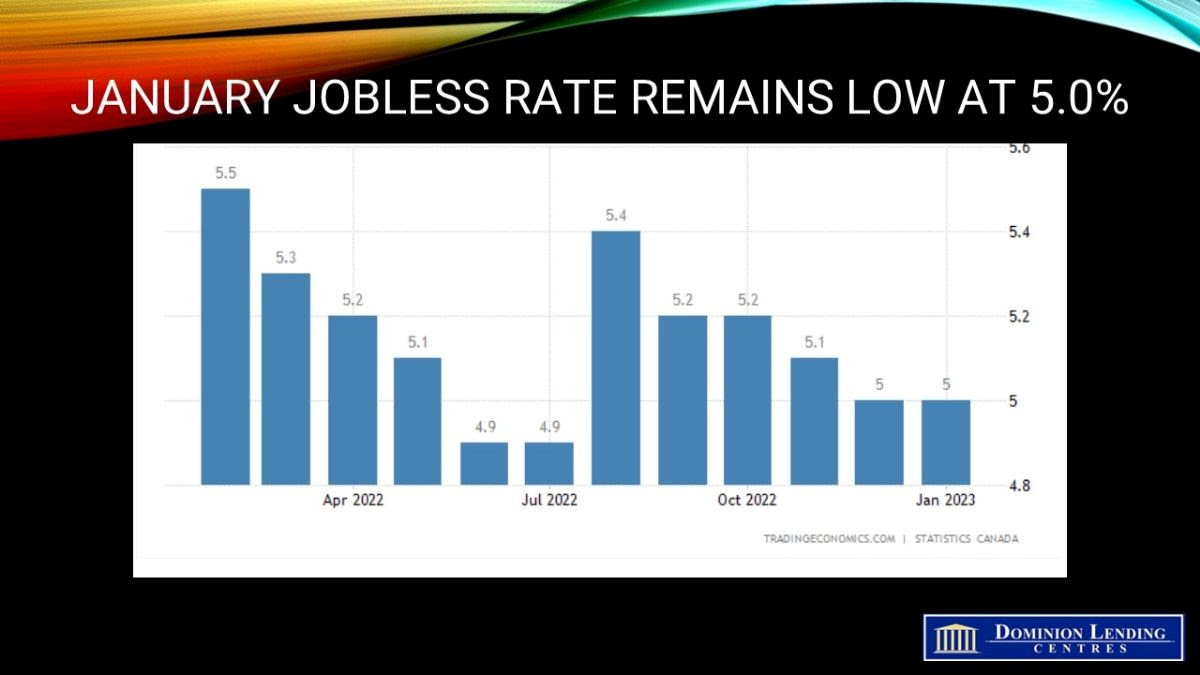
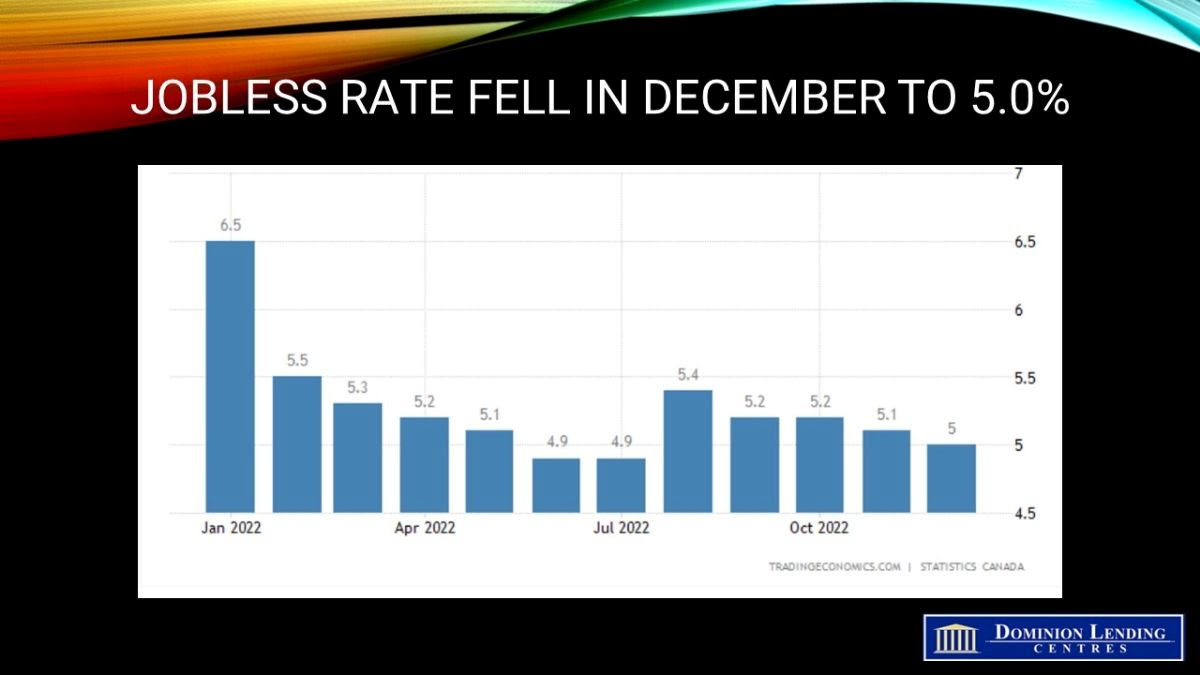
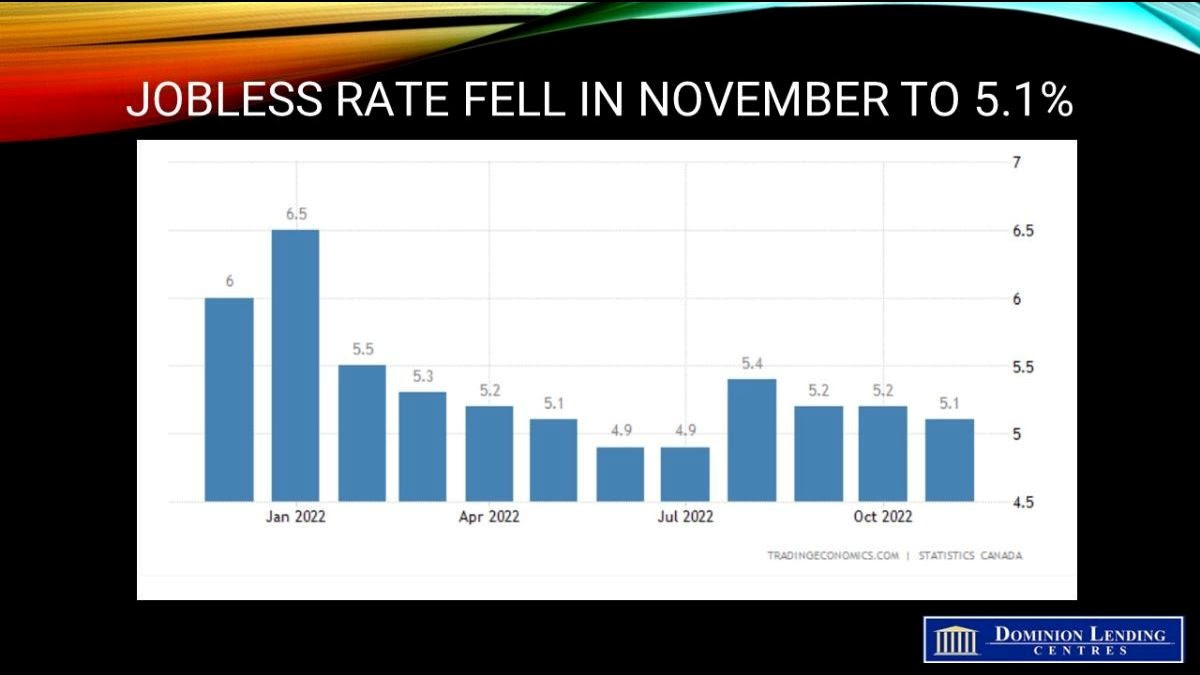
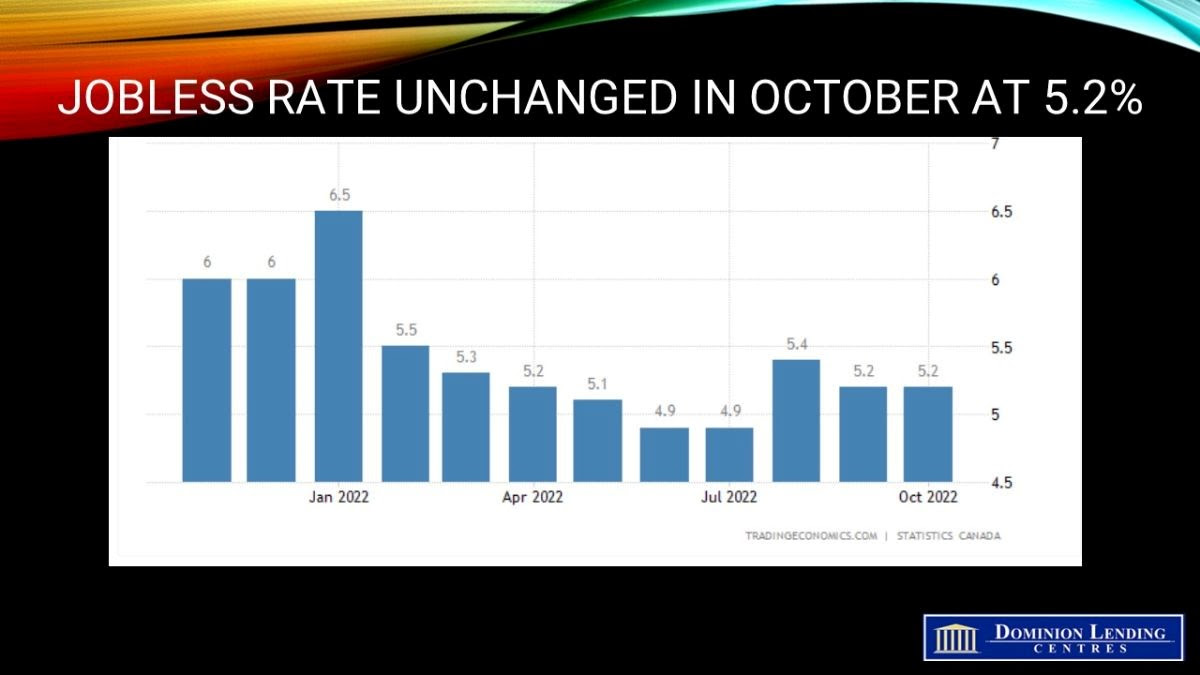
After declining in September, the unemployment rate remained at 5.2% in October, 0.3 percentage points above the record low of 4.9% observed in June and July. The adjusted unemployment rate—which includes people who wanted a job but did not look for one—was virtually unchanged in October at 7.1%.

In October, the labour force—or the total number of people who are either employed or unemployed—was 110,000 (+0.5%) more significant than in September. The labour force participation rate rose 0.2 percentage points to 64.9% in October but fell 0.5 percentage points short of the recent high of 65.4% in February and March 2022.

Employment rebounded in construction and manufacturing. The number of people working in construction rose by 25,000 (+1.6%) in October, with increases in five provinces, including Quebec (+17,000; +5.9%) and British Columbia (+6,000; +2.5%). Despite this increase, employment in construction was virtually unchanged in October compared with March 2022, consistent with the latest data on gross domestic product showing slowing economic activity in the industry over a similar period.

Employment rose by 24,000 (+1.4%) in manufacturing, mainly offsetting the decrease of 28,000 (-1.6%) recorded in September. Most of the increase was attributable to British Columbia (+12,000; +6.9%) and Nova Scotia (+3,700; +11.6%). On a year-over-year basis, employment in manufacturing was little changed.

The number of people working in accommodation and food services increased by 18,000 (+1.7%) in October, the first increase in the industry since May. According to the latest data from the Job Vacancy and Wage Survey, the industry had a higher job vacancy rate than all other industries in August.

Employment in professional, scientific and technical services rose by 18,000 in October (+1.0%), the third increase in six months. The number of people working in the industry has followed a long-term upward trend since June 2020, and in October was 297,000 (+19.3%) above its pre-pandemic level.

In October, the number of people working in wholesale and retail trade declined by 20,000 (-0.7%). Employment in the industry last increased in May and was little changed on a year-over-year basis in October. According to the latest data on retail trade, while retail sales increased 0.7% to $61.8 billion in August, advance estimates suggest that sales decreased 0.5% in September.

Of paramount importance to the Bank of Canada’s endeavours to wrestle inflation to a 2% pace, average hourly wages last month were 5.6% higher than one year earlier, accelerating from a rate of 5.2% in September. Despite average wages growing by more than 5% on a year-over-year basis in each of the past five months, they have not kept pace with inflation, which was 6.9% in September, contributing to concerns about affordability and the cost of living for many Canadians.

In separate news, the US employment data for October were also released today, showing stronger-than-expected hiring and wage gains, while the jobless rate ticked up a bit more than expected.

Bottom Line

Today’s labour force data in Canada throws into question the widespread assumption that the Bank of Canada can ease off the brakes very soon. I believe Governor Tiff Macklem will hike rates by another 50 bps in December and continue with 25 bp increases early next year. Today’s employment report raised the odds of the peak in the policy target of 4.5%.

Dr. Sherry Cooper
Chief Economist, Dominion Lending Centres
drsherrycooper@dominionlending.ca
1 Nov

The Bank of Canada Slowed the Pace of Monetary Tightening by Dr Sherry Cooper

General

Posted by: Liz Fraser

The Bank of Canada Slowed the Pace of Monetary Tightening
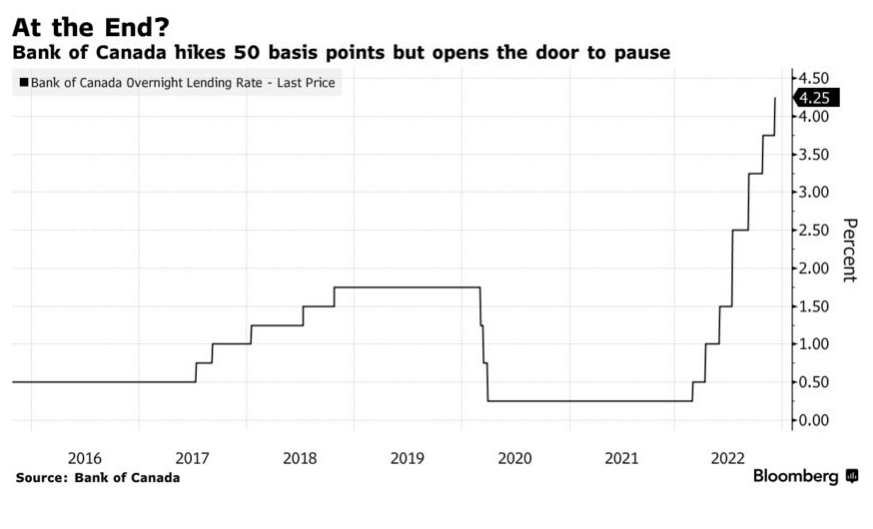
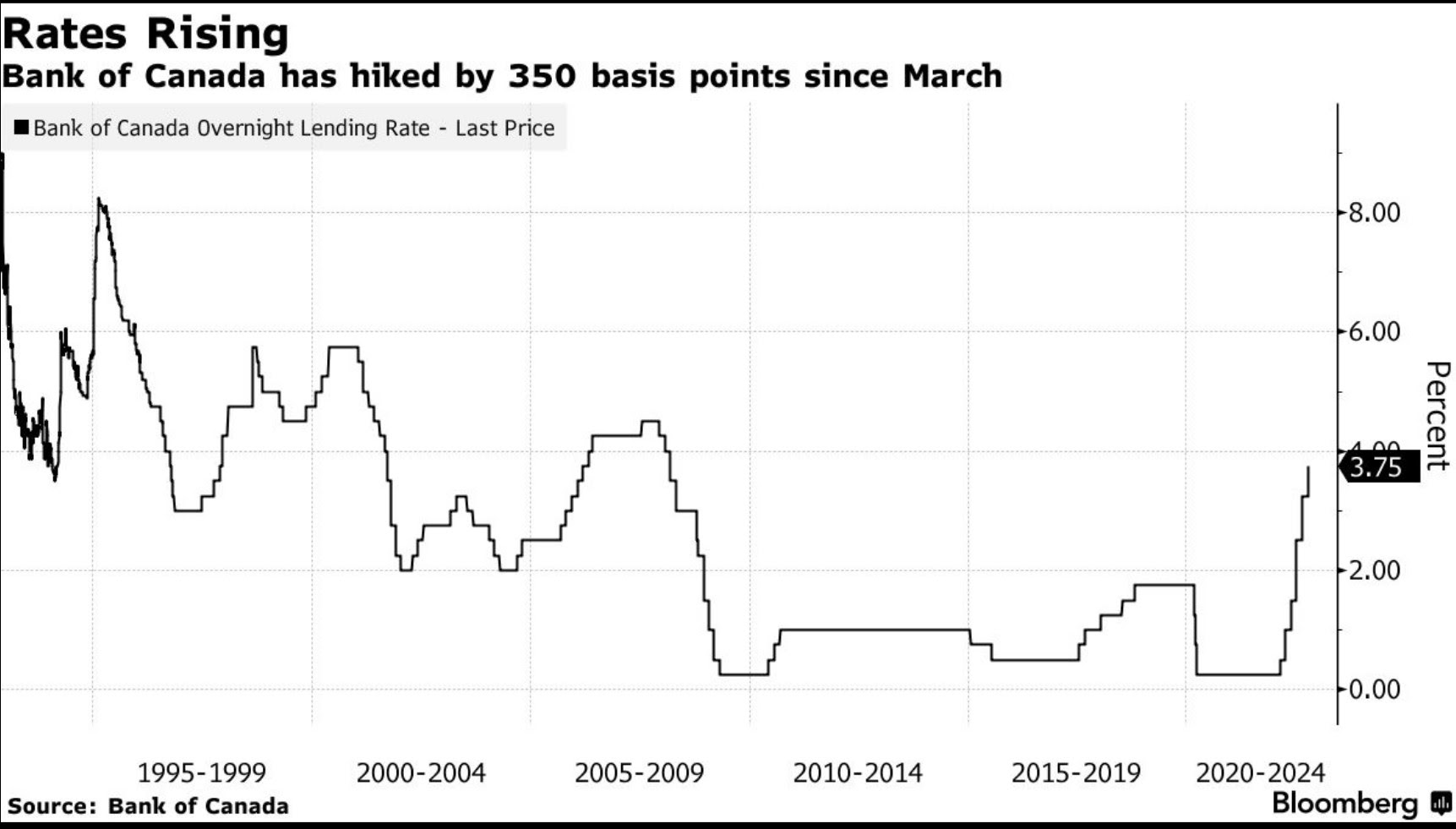
The Governing Council of the Bank of Canada raised its target for the overnight policy rate by 50 basis points today to 3.75% and signalled that the policy rate would rise further. The Bank is also continuing its policy of quantitative tightening (QT), reducing its holdings of Government of Canada bonds, which puts additional upward pressure on longer-term interest rates.

Most market analysts had expected a 75 bps hike in response to the disappointing inflation data for September. Headline inflation has slowed from 8.1% to 6.9% over the past three months, primarily due to the fall in gasoline prices. However, the Bank said that “price pressures remain broadly based, with two-thirds of CPI components increasing more than 5% over the past year. The Bank’s preferred measures of core inflation are not yet showing meaningful evidence that underlying price pressures are easing. Near-term inflation expectations remain high, increasing the risk that elevated inflation becomes entrenched.”

In his press conference, Governor Tiff Macklem said that the Bank chose to reduce today’s rate hike from 75 bps last month (and 100 bps in July) to today’s 50 bps because “there is evidence that the economy is slowing.” When asked if this is a pivot from very big rate increases, Macklem said that further rate increases are coming, but how large they will be is data-dependent. Global factors will also influence future Bank of Canada actions.

“The Bank expects CPI inflation to ease as higher interest rates help rebalance demand and supply, price pressures from global supply disruptions fade, and the past effects of higher commodity prices dissipate. CPI inflation is projected to move down to about 3% by the end of 2023 and then return to the 2% target by the end of 2024.”

The press release concluded with the following statement: “Given elevated inflation and inflation expectations, as well as ongoing demand pressures in the economy, the Governing Council expects that the policy interest rate will need to rise further. Future rate increases will be influenced by our assessments of how tighter monetary policy is working to slow demand, how supply challenges are resolving, and how inflation and inflation expectations are responding. Quantitative tightening is complementing increases in the policy rate. We are resolute in our commitment to restore price stability for Canadians and will continue to take action as required to achieve the 2% inflation target.”

Reading the tea leaves here, the fact that the Bank of Canada referred to ‘increases’ in interest rates in the plural suggests it will not be just one more hike and done.

Monetary Policy Report (MPR)

The Bank of Canada released its latest global and Canadian economies forecast in their October MPR. They have reduced their outlook across the board. Concerning the Canadian outlook, GDP growth in 2022 has been revised down by about ¼ of a percentage point to around 3¼%. It has been reduced by close to 1 percentage point in 2023 and almost ½ of a percentage point in 2024, to about 1% and 2%, respectively. These revisions leave the level of real GDP about 1½% lower by the end of 2024.

Consumer price index (CPI) inflation in 2022 and 2023 is anticipated to be lower than previously projected. The outlook for CPI inflation has been revised down by ¼ of a percentage point to just under 7% in 2022 and by ½ of a percentage point to about 4% in 2023. The outlook for inflation in 2024 is largely unchanged. The downward revisions are mainly due to lower gasoline prices and weaker demand. Easing global cost pressures, including lower-than-expected shipping costs, also contribute to reducing inflation in 2023. The weaker Canadian dollar partially offsets these cost pressures.

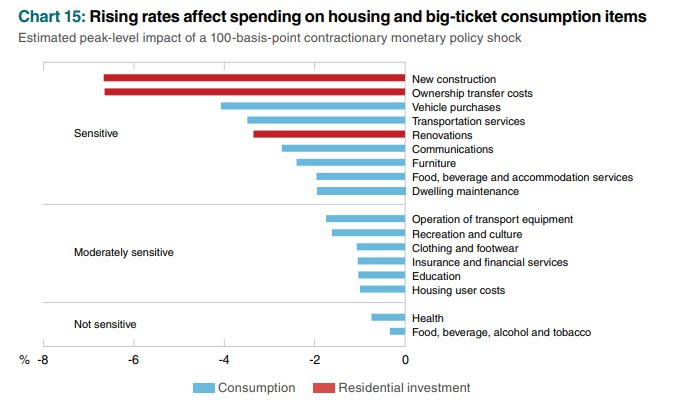
The Bank is expecting lower household spending growth. Consumer spending is expected to contract modestly in Q4 of this year and through the first half of next year. Higher interest rates weigh on household spending, with housing and big-ticket items most affected (Chart below). Decreasing house prices, financial wealth and consumer confidence also restrain household spending. Borrowing costs have risen sharply. The costs for those taking on a new mortgage are up markedly. Households renewing an existing mortgage are facing a larger increase than has been experienced during any tightening cycle over the past 30 years. For example, a homeowner who signed a five-year fixed-rate mortgage in October 2017 would now be faced with a mortgage rate of 1½ to 2 percentage points higher at renewal.

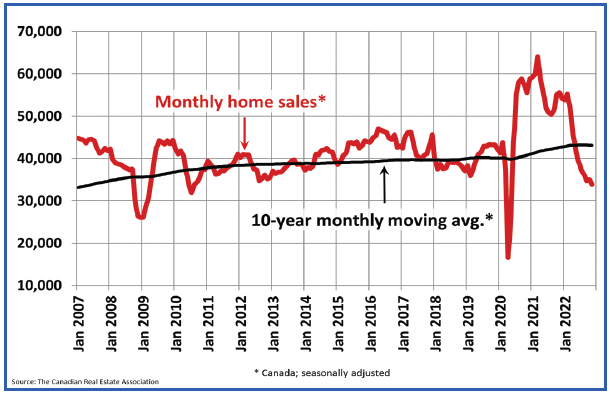
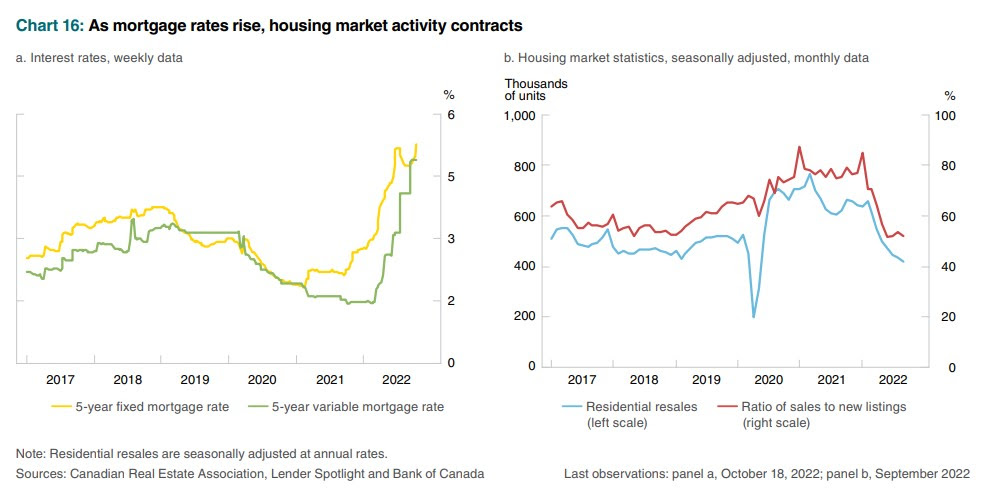
Housing activity is the most interest-sensitive component of household spending. It provides the economy’s most important transmission mechanism of monetary tightening (or easing). The rise in mortgage rates contributed to a sharp pullback in resales beginning in March. Resales have declined and are now below pre-pandemic levels (Chart below). Renovation activity has also weakened. The contraction in residential investment that began in the year’s second quarter is projected to continue through the first half of 2023, although to a lesser degree. House prices rose by just over 50% between February 2020 and February 2022 and have declined by just under 10%. They are projected by the Bank of Canada to continue to decline, particularly in those markets that saw larger increases during the pandemic.

Higher borrowing costs are affecting spending on big-ticket items. Spending on automobiles, furniture and appliances is the most sensitive to interest rates and is already showing signs of slowing. As higher interest rates work their way through the economy, disposable income growth and the demand for services will also slow. Past experience suggests that the demand for travel, hotels, restaurant meals and communications services will be impacted the most. Household spending strengthens beginning in the second half of 2023 and extends through 2024. Population growth and rising disposable incomes support demand as the impact of the tightening in financial conditions wanes. For example, new residential construction is boosted by strong immigration in markets that are already particularly tight.

Governor Macklem and his officials raised the prospect of a technical recession. “A couple of quarters with growth slightly below zero is just as likely as a couple of quarters with small positive growth” in the first half of next year, the bank said in the MPR.

Bottom Line

The Bank of Canada’s surprising decision today to hike interest rates by 50 bps, 25 bps less than expected, reflected the Bank’s significant downgrade to the economic outlook. Weaker growth is expected to dampen inflation pressures sufficiently to warrant today’s smaller move.

A 50 bps rate hike is still an aggressive move, and the implications are considerable for the housing market. The prime rate will now quickly rise to 5.95%, increasing the variable mortgage interest rate another 50 bps, which will likely take the qualifying rate to roughly 7.5%.

Fixed mortgage rates, tied to the 5-year government of Canada bond yield, will be less affected. The 5-year bond yield declined sharply today–down nearly 25 bps to 3.42%–with the smaller-than-expected rate hike.

Barring substantial further weakening in the economy or a big move in inflation, I expect the Bank of Canada to raise rates again in December by 25 bps and then again once or twice in 2023. The terminal overnight target rate will likely be 4.5%, and the Bank will hold firm for the rest of the year. Of course, this is data-dependent, and the level of uncertainty is elevated.

Dr. Sherry Cooper
Chief Economist, Dominion Lending Centres
drsherrycooper@dominionlending.ca
29 Oct

Canadian Inflation Too Hot For Comfort in September

General

Posted by: Liz Fraser

Bank of Canada Will Not Be Happy With This Inflation Report
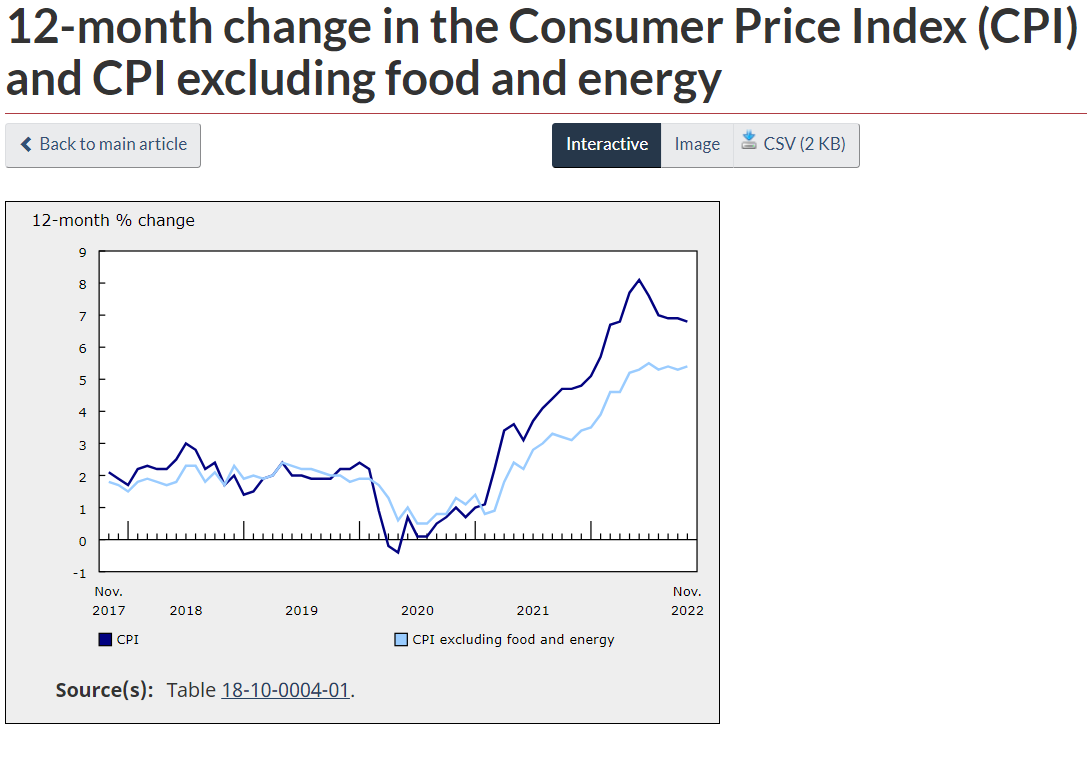
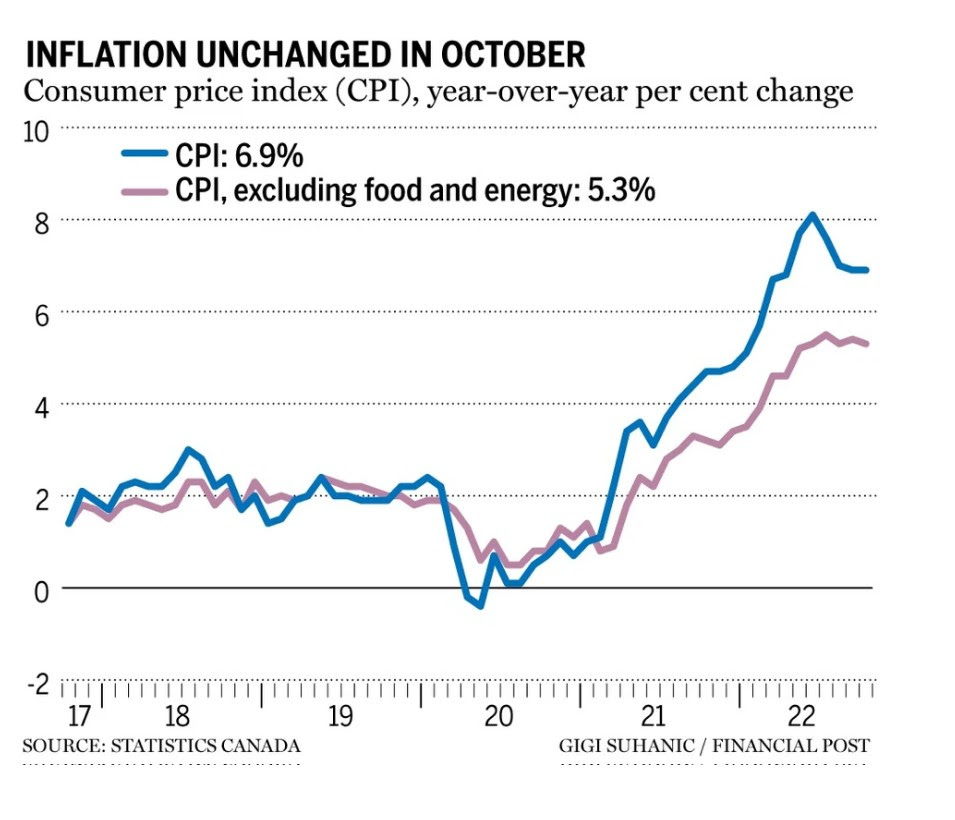
Canada’s headline inflation rate ticked down slightly last month to 6.9%, but measures of core inflation remain stubbornly high, and food prices hit a 41-year high. Lower gasoline prices were primarily responsible for the decline in inflation in the past three months. Bond markets sold off on the immediate release of the data this morning, taking the 2-year yield on Government of Canada bonds to over 4%. This is the last major data release before the Bank of Canada’s policy rate announcement next Wednesday, October 26, which puts the potential for a 75-bps hike back in play. At the very least, the Bank will take the overnight rate up 50 bps to 3.75%, but I wouldn’t rule out another 75-bps move. Judging from experience, we may see a nod in that direction by Governor Macklem before the Governing Council meets.

Excluding food and energy, prices rose 5.4% year-over-year (y/y) in September, following a gain of 5.3% in August. Prices for durable goods, such as furniture and passenger vehicles, grew faster in September compared with August. In September, the Mortgage Interest Cost Index continued to put upward pressure on the all-items CPI Canadians renewed or initiated mortgages at higher interest rates.

Monthly, the CPI rose 0.1% in September. On a seasonally adjusted monthly basis, the CPI was up 0.4%.
Average hourly wages rose 5.2% on a year-over-year basis in September, meaning that, on average, prices rose faster than wages. The gap in September was larger compared with August.

In September, prices for food purchased from stores (+11.4%) grew faster year-over-year since August 1981 (+11.9%). Prices for food purchased from stores have increased faster than the all-items CPI for ten consecutive months since December 2021.

Contributing to price increases for food and beverages were unfavourable weather, higher prices for essential inputs such as fertilizer and natural gas, and geopolitical instability stemming from Russia’s invasion of Ukraine.

Food price growth remained broad-based in September. On a year-over-year basis, Canadians paid more for meat (+7.6%), dairy products (+9.7%), bakery products (+14.8%), and fresh vegetables (+11.8%), among other food items.

Bottom Line

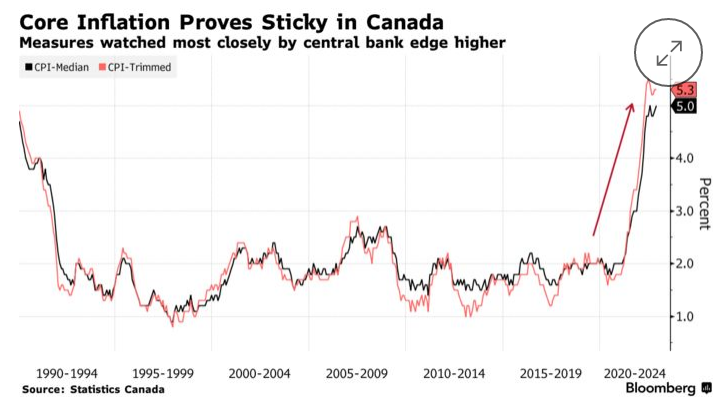
Price pressures might have peaked, but today’s data release will not be welcome news for the Bank of Canada. There is no evidence that core inflation is moderating despite the housing and consumer spending slowdown. The average of the Bank’s favourite measure of core inflation remains stuck at 5.3%. Combined with the Governor’s recent harsh rhetoric, the high probability that the Fed will hike rates 75 bps at the next Federal Open Market Committee Meeting and the weak Canadian dollar, there is no doubt the Bank will increase their overnight policy target to at least 3.75%, and could well go the full 75 bps to 4.0% next week. I would bet that they will not quit there, with further hikes to come in December and next year by central banks worldwide.

The Government of Canada yield curve is now steeply inverted, reflecting the widely held expectation that the economy is slowing. The prime rate will increase sharply next week, increasing variable mortgage rates again. Fixed mortgage rates will rise as well, but not by as much, continuing a pattern we’ve seen since March when the Bank of Canada began the current tightening cycle. We are unlikely to see a pivot to lower rates in the next year as inflation pressures remain very sticky.

Dr. Sherry Cooper
Chief Economist, Dominion Lending Centres
drsherrycooper@dominionlending.ca
29 Oct

Canadian Housing Update by Dr Sherry Cooper

General

Posted by: Liz Fraser

Orderly Housing Correction Continues
There are many unusual aspects to the current housing correction, but fundamentally the most noteworthy is how orderly and non-chaotic it has been. Home sales have slowed, but so have new listings, so the price declines are more muted than we might have expected. This is not a housing collapse. It is a housing correction. We’ve seen little distressed selling, as most would-be sellers have lots of home equity and low mortgage rates–not anxious to buy new properties immediately. Moreover, with rents surging, most potential down-sizers aren’t keen to make that trade-off.

The full effects of the most recent rate hikes have not yet manifested. Statistics released today by the Canadian Real Estate Association (CREA) show that the slowdown that began in March in response to higher interest rates continued in September. Home sales recorded over Canadian MLS® Systems fell by 3.9% between August and September 2022. From May through August, month-over-month declines have been progressively smaller. The September result marked a slight increase in the current sales slowdown that began with the Bank of Canada’s first rate hike back in March.

While about 60% of all local markets saw sales fall from August to September, the national number was pulled lower by the fact markets with declines included Greater Vancouver, Calgary, the Greater Toronto Area (GTA) and Montreal.

The actual (not seasonally adjusted) number of transactions in September 2022 came in 32.2% below that same month last year. It stood about 12% below the pre-pandemic 10-year average for that month (see chart below).

“September was another month of lower sales activity, although, with many sellers also opting to play the waiting game, the market remains on the tighter side of balanced market territory,” said Jill Oudil, Chair of CREA. “It makes for an interesting dynamic, one that doesn’t really have many historical precedents. The market has changed so much in the last year, and the adjustment to higher borrowing costs is still underway.”

“Up until recently, higher borrowing costs had disproportionally affected the fixed-rate space, with buyers able to qualify more easily if they went with a variable rate mortgage,” said Shaun Cathcart, CREA’s Senior Economist. “The Bank of Canada’s most recent rate hike in early September finally closed that door, so it was not a big surprise to see additional softness on the sales side. The important thing to remember is we’re still in the middle of a period of rapid adjustment, with buyers and sellers trying to feel each other out while a lot of people have had to take their home search plans back to the drawing board. As such, resale markets may remain on the quiet side for some time yet, with the flipside of that coin being even more pressure on rental markets.”

New Listings
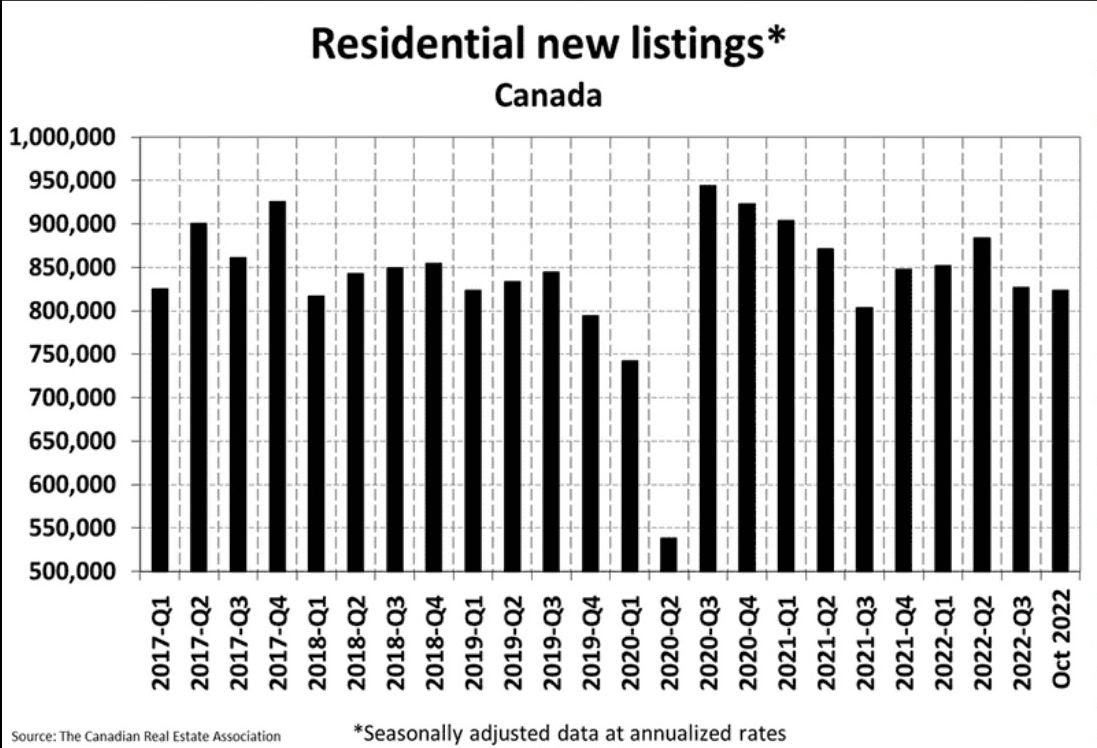
The supply of homes is still historically low. The number of newly listed homes edged back a further 0.8% on a month-over-month basis in September. This built on the 6.1% and 4.9% declines recorded in July and August, respectively, as some sellers appear content to stay on the sidelines until more buyers are ready to get back into the market. It was an even split between markets where new supply was down in September and those where it increased, with the most significant declines in the GTA offsetting the largest gains in British Columbia’s Lower Mainland.

Unusually, new listings would be so listless during a housing slowdown. However, the CREA data only go back 42 years, when interest rates trended sharply downward. Sellers today typically have mortgages at far lower than current rates, which no doubt dampens their enthusiasm to sell. Distressed sellers apparently listed their homes earlier this cycle, with the rest remaining on the sidelines for now. That could change if interest rates rise substantially further, although the incentives to stay in place continue high.

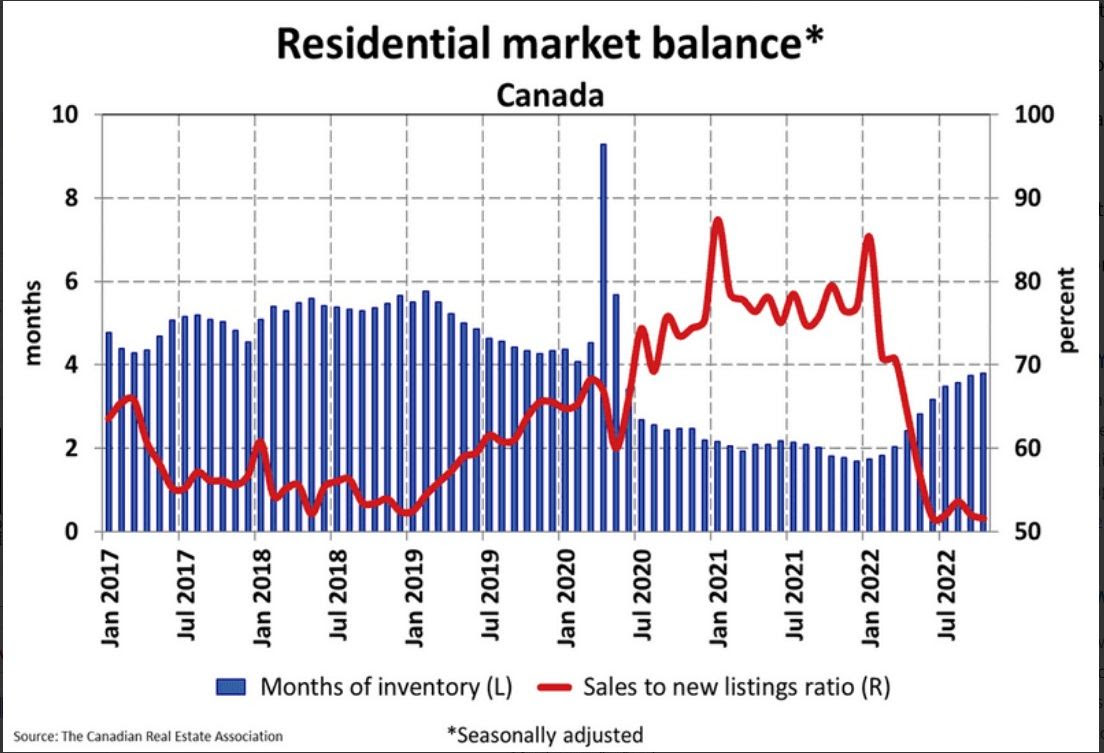
With sales down and new listings seeing a minor change in September, the sales-to-new listings ratio eased to 52% compared to 53.6% in August. The September 2022 reading for the national sales-to-new listings ratio was back on par with those in June and July and slightly below its long-term average of 55.1%.

There were 3.7 months of inventory on a national basis at the end of September 2022, up slightly from 3.5 months at the end of August. While the number of months of inventory is still well below the long-term average of about five months, it’s also up quite a bit from the all-time low of 1.7 months set at the beginning of 2022.

Home Prices
The Aggregate Composite MLS® Home Price Index (HPI) edged down 1.6% on a month-over-month basis in August 2022, not a small decline historically, but smaller than in June and July.

Breaking it down regionally, most of the monthly declines in recent months have been in markets across Ontario and, to a lesser extent, in British Columbia; however, in August, Ontario markets contributed most to the overall national decline.

Looking across the Prairies, prices in Alberta appear to have peaked. Prices still rise slightly in Saskatchewan, while Manitoba recorded the only decline. In Quebec, prices have dipped somewhat in the last couple of months. On the East coast, the softening of prices confined to Halifax-Dartmouth is now also appearing in New Brunswick, Newfoundland and Labrador. By contrast, prices in PEI continue to edge ahead on a month-over-month basis.

The non-seasonally adjusted Aggregate Composite MLS® HPI was still up by 7.1% on a year-over-year basis in August. This was the first single-digit increase in almost two years, as year-over-year comparisons have been winding down at a brisk pace from the near-30% record year-over-year gains logged just six months ago.
The Aggregate Composite MLS® HPI edged down 1.4% on a month-over-month basis in September 2022, not a small decline historically, but smaller than in June, July and August.

Breaking it down regionally, most of the recent monthly declines had been in markets across Ontario and, to a lesser extent, in B.C. The standout trend in August and September was that quite a few of those Ontario markets saw monthly price declines get stopped in their tracks, mainly in the Greater Golden Horseshoe. In a few markets prices even popped up a bit between August and September.

Looking across the Prairies, prices in Edmonton and Winnipeg are down a bit from their peaks, while prices are sliding sideways in Calgary, Regina, and Saskatoon. Similarly in Quebec, prices have dipped in Montreal but are mostly flat in Quebec City.

On the East Coast, price softness that had been confined to the Halifax-Dartmouth area appears to now be showing up in parts of New Brunswick and Newfoundland and Labrador, while prices in Prince Edward Island have flattened out in recent months but have not yet moved any lower.

The non-seasonally adjusted Aggregate Composite MLS® HPI was still up by 3.3% on a year-over-year basis in September, a far cry from the near-30% record year-over-year gains logged in early 2022.

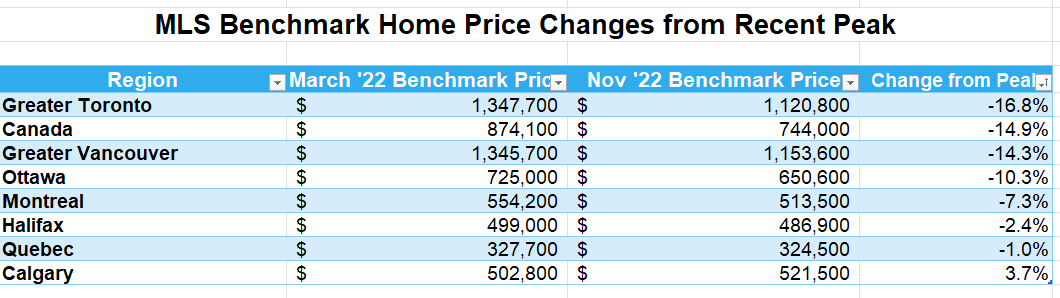
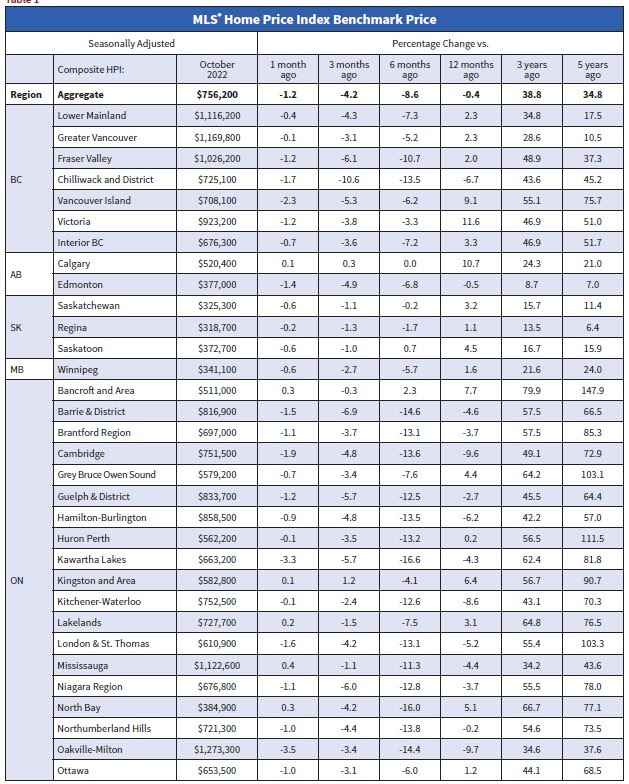
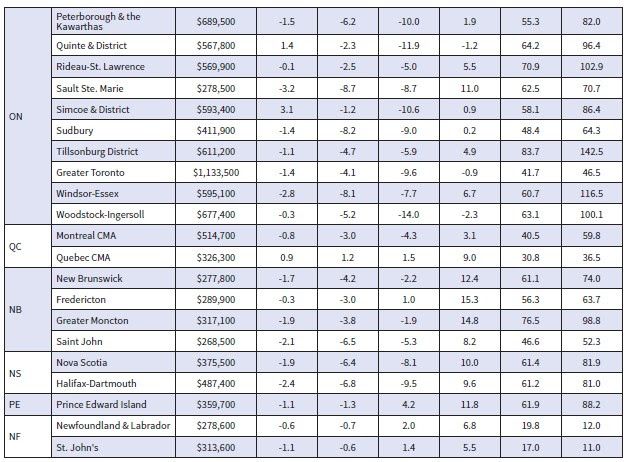
The table below shows the decline in average home prices in Canada and selected cities since prices peaked in March when the Bank of Canada began hiking interest rates. More details follow in the second table below. The largest price dips are in the GTA and the GVA, where the price gains were spectacular during the Covid-shutdown.
US Inflation Surprises on the High Side in September

In other news, US CPI data, released yesterday for September, show inflation remains stubbornly high, assuring another 75 bps increase in the US overnight policy rate when the Fed meets again on November 3.

A closely watched measure of US consumer prices rose by more than forecast to a 40-year high last month, pressuring the Federal Reserve to raise interest rates even more aggressively. The core consumer price index, which excludes food and energy, increased 6.6% from a year ago, the highest level since 1982. From a month earlier, the core CPI climbed 0.6%. On the heels of a solid jobs report last week and record-low unemployment, the inflation data likely cement an additional 75-basis point interest rate hike at the Fed’s November policy meeting. Even more noteworthy, however, is that immediately following the release of the inflation report, the market assessment of the maximum overnight rate rose from 4.6% to 4.85% for March of next year, substantially above the current overnight rate of 3.25%.

Bottom Line

The Bank of Canada’s next policy announcement date is October 26, when we will likely see another hike in the overnight policy target of at least 50 bps to 3.75%. Much will depend on next week’s release of the September CPI report for Canada on Wednesday, October 19. All eyes will be on the Bank’s measures of core inflation, which have been stubbornly sticky at above 5% on average. If the data disappoint on the high side, we can’t rule out a 75-bps rate hike the following week.

I believe both the Bank of Canada and the Fed will hike overnight rates further later this year and into next year. They are also not likely to begin to reverse these rate hikes until 2024.

Dr. Sherry Cooper
Chief Economist, Dominion Lending Centres
drsherrycooper@dominionlending.ca
12 Oct

Tiff Macklem and Jay Powell Are Emulating Paul Volcker by Dr Sherry Cooper

General

Posted by: Liz Fraser

Forty-Three Years Ago, I Was Fed Chair Paul Volcker’s Special Assistant
Inflation appears to be book-ending my career. I started my work as an economist in the Research Division of the Federal Reserve Board in Washington, D.C., in the late 1970s. Inflation had been trending higher for years. Neither Arthur Burns nor G. William Miller, the Fed chairmen preceding Volcker, had the fortitude to raise interest rates sufficiently and keep them there long enough to reduce inflation to a low sustainable pace. Paul Volcker pulled it off–for which he was personally vilified at the time. But since then, Paul Volcker has become a legend, esteemed as the central banker whose brute-force campaign subdued inflation for decades.

You can see in the chart below that in late 1979, the Volcker Fed hiked the overnight policy rate to levels well above the inflation rate and kept real interest rates (nominal rate minus inflation rate) positive for an extended period.

The current Fed Chair, Jay Powell, has expressed deep admiration for Paul Volcker, calling him “the greatest economic public servant of the era.” Last month, Powell alluded to his predecessor’s record of persistence, saying that policymakers “will keep at it until the job is done” — invoking Volcker’s memoir, “Keeping at It.”

The Bank of Canada was no slouch on the inflation front as well. As the chart shows, the Bank hiked interest rates in lockstep with the Fed in the Volcker years and even more in the early 1990s when Ottawa was fighting Canadian budgetary red ink to the ground.

This time around, Tiff Macklem has been ahead of the Fed in hiking interest rates and, in a speech on Thursday, said that the economy is still “clearly” in excess demand, with businesses facing an extremely tight labour market, wage gains broadening and underlying inflation pressures showing no signs of letting up. Macklem said that the sources of inflation, which started with goods prices, are broadening to the service sector. “. Labour markets remain very tight. Job vacancies have eased a little in recent months but remain exceptionally high. Our business surveys report widespread labour shortages. And wage growth has risen and continues to broaden.”

“With demand running ahead of supply, competition is posing less of a restraint on price increases, and businesses are passing through higher input costs more quickly. As a result, higher energy and material costs are showing up in the prices of a growing list of goods and services. So even if there is some relief at the gas pumps, price pressures remain high and continue to broaden. In August, the prices of more than three-quarters of the goods and services that make up the CPI were rising faster than 3%.”

Macklem continued, “As we look for a more fundamental turning point in inflation, measures of core inflation are becoming increasingly relevant…after taking out volatile components in the CPI that don’t reflect generalized changes in prices, inflation is running about 5%. That’s too high. We can also see that our core measures have yet to decline meaningfully even though total CPI inflation has come down in the last couple of months. Going forward, we will be watching our measures of core inflation closely for clear evidence of a turning point in underlying inflation.” In conclusion, the governor said, “there is more to be done….We know we are still a long way from the 2% target. We know it will take some time to get there. We also know there could be setbacks along the way, and we can’t afford to let high inflation become entrenched.”

So given the clear statements by the Fed and the Bank of Canada, it makes no sense why Bay Street economists are betting that the overnight rate in Canada will peak at around 4% by yearend. They are still forecasting a decline in short-term interest rates next year due to a slowdown in economic activity. I don’t buy that.

There are many views on how far the central banks will have to hike rates from here, but the critical issue is to reach a point where rates are meaningfully restrictive. A rule of thumb is that the overnight policy rate must rise to exceed the inflation rate. Fed Chairman Powell has said that he believes that real interest rates should be positive across the yield curve. Today, long and short US rates are still the lowest compared to inflation since the Burns era in the mid-1970s. (see chart below). Traders are betting that the US overnight rate will rise another 125 basis points (bps) by yearend and continue to rise next year to a median estimate of 4.6%.

Chair Powell has clarified that he is willing to tolerate much slower growth. As Bloomberg economists suggest, “Canada is seen having both faster growth and lower interest rates over the next three years — a peculiar mix of economic outcomes that assumes the country is more buffered from global headwinds — including a potential US recession — but won’t face the same pressure to match the Fed higher.”

Short-term money markets are betting the Bank of Canada will stop its hiking cycle at about 4%, versus a Fed benchmark rate peaking at about 4.6% and remaining below US short-term rates for at least another three years.

This is especially unreasonable given the fall in the Canadian dollar, which is now trading at US$0.728 compared to US$0.814 one year ago. This depreciation reflects the inordinate strength of the US dollar–the global safe-haven currency in a time of enormous uncertainty and volatility. The Canadian dollar has fared far better than other G-7 countries over this period. But the decline in our currency will raise the prices of the many US products and services we import, adding to inflation.

Inverted Yield Curves

In Canada and the US, 2-year yields have risen sharply to levels well above 5-year yields. As of October 6, the 2-year Government of Canada bond yield is at 4.0% compared to the 5-year yield at 3.49% and the 10-year yield at 3.31%. This implies the markets expect a slowdown in economic activity, but that does not mean that the overnight policy rate will fall in 2023 as Bay Street expects, especially if core inflation remains well above 2%. The Canadian prime rate is currently 5.45%, well above the 5-year yield of 3.49%. When the Bank of Canada Governing Council meets again on October 26, it will likely raise the policy rate by at least 50 bps to 3.75%, taking the prime rate up to 5.95% or higher—clearly improving the relative attractiveness of fixed-rate mortgage loans.

Bottom Line

For most of my readers, inflation is a brand-new experience, and so are rising interest rates. Inflation in Canada was at 2.2% when the pandemic began, and the 5-year bond yield was a mere 1.3%. Quickly the central bank cut the overnight rate from 1.75% to 0.25%, the prime rate fell from 3.95% to 2.45%, and the 5-year bond yield fell to a low of about 0.32%. Housing demand exploded and continued strong until it peaked in February 2022 when the Bank of Canada began to hike interest rates.

Interest rates will not fall to pre-pandemic levels next year or even the year after. And we will likely never see interest rates at pandemic levels again, at least I hope not, because it would take another global economic shutdown. Hence, mortgage-borrower psychology will change. Many more homeowners will choose to lock in fixed interest rates, and by the time this is over, a new generation will realize that interest rates don’t just fall but sometimes rise to levels higher than expected and stay there longer than expected—a painful lesson to learn.

Dr. Sherry Cooper
Chief Economist, Dominion Lending Centres
drsherrycooper@dominionlending.ca
12 Oct

Canadian Labour Force Survey in September Strong Enough To Keep Bank of Canada On Hawkish Path

General

Posted by: Liz Fraser

Tight Labour Market Fuels Higher Wages
Today’s Labour Force Survey showed that employment grew in September for the first time in four months. Job gains remained moderate despite the high number of vacancies, indicating how tight the job market remains. Wage rates rose 5.2% year-over-year (y/y), the fourth consecutive month for which wage gains exceeded 5%. The jobless rate ticked downward, retracing some of the rise posted in August.

Canada added just over 21,000 jobs last month, with both full-time and part-time work increasing. Gains in educational services, health care, and social assistance were offset by losses in manufacturing; information, culture and recreation; transportation and warehousing, and public administration.

Employment increased in four provinces, led by British Columbia, while fewer people were working in Ontario and Prince Edward Island.

Total hours worked were down 0.6% in September 2022. Despite declining by 1.1% since June, total hours worked were up 2.4% y/y.

In separate news, the US employment data for September was also released today, showing a moderate dip in job growth from the August data, although the gains remained strong. The jobless rate fell to 3.5% from 3.7% a month earlier. The persistent strength in hiring underscored the challenges facing the Federal Reserve as it tries to curtail job growth enough to tame inflation.

Bottom Line

Today’s labour force data in Canada and the US do nothing to deter the central banks from their rate-hiking paths. This is the last employment report before their decision dates–October 26th for the Bank of Canada and November 2nd for the Fed–although we will see the release of inflation and housing data before they meet again. It is already baked into the cake that rate hikes will continue.

Both central banks recently cautioned against market expectations that the fight against inflation was nearly over. Today’s data reinforce what we have already been told.

Dr. Sherry Cooper
Chief Economist, Dominion Lending Centres
drsherrycooper@dominionlending.ca
20 Sep

Canadian Inflation Slows For the Second Consecutive Month by Dr Sherry Cooper

General

Posted by: Liz Fraser

Inflation Cooled Again in August, But Higher Rates Still Coming
Canada’s headline inflation rate cooled again in August, even a bit more than expected. The consumer price index rose 7.0% from a year ago, down from 7.6% in July and a forty-year high of 8.1% in June, mainly on the back of lower gasoline prices.

The CPI fell 0.3% in August, the most significant monthly decline since the early months of the COVID-19 pandemic. On a seasonally adjusted monthly basis, the CPI was up 0.1%, the smallest gain since December 2020. The monthly gas price decline in August compared with July mainly stemmed from higher global production by oil-producing countries. According to data from Natural Resources Canada, refining margins also fell from higher levels in July.Transportation (+10.3%) and shelter (+6.6%) prices drove the deceleration in consumer prices in August. Moderating the slowing in prices were sustained higher prices for groceries, as prices for food purchased from stores (+10.8%) rose at the fastest pace since August 1981 (+11.9%).

Price growth for goods and services both slowed on a year-over-year basis in August. As non-durable goods (+10.8%) decelerated due to lower prices at the pump, services associated with travel and shelter services contributed the most to the slowdown in service prices (+5.5%). Prices for durable goods (+6.0%), such as passenger vehicles and appliances, also cooled in August.

In August, the average hourly wages rose 5.4% on a year-over-year basis, meaning that, on average, prices rose faster than wages. Although Canadians experienced a decline in purchasing power, the gap was smaller than in July.

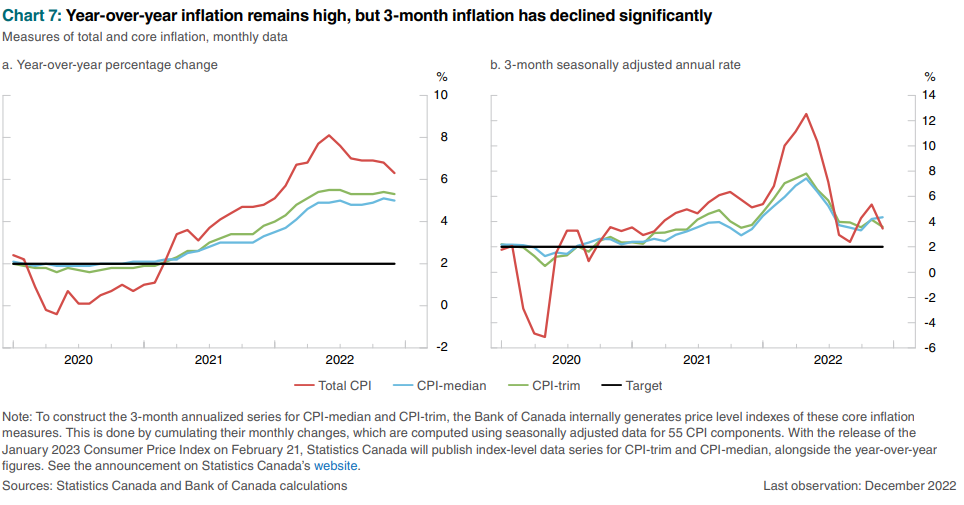
Core inflation–which excludes food and energy prices–also decelerated but remains far too high for the Bank of Canada’s comfort.  The central bank analyzes three measures of core inflation (see the chart below). The average of the central bank’s three key measures dropped to 5.23% from a revised 5.43% in July, a record high. The Bank aims to return these measures to their 2% target..

Bottom Line

Price pressures might have peaked, but today’s data release will not derail the central bank’s intention to raise rates further. Markets expect another rate hike in late October when the Governing Council of the Bank of Canada meets again. But further moves are likely to be smaller than the 75 bps-hikes of the past summer.

There is still more than a month of data before the October 25th decision date. The September employment report (released on October 7) and the September CPI (October 19) will be critical to the Bank’s decision. Right now, we expect a 50-bps hike next month.

Dr. Sherry Cooper
Chief Economist, Dominion Lending Centres
drsherrycooper@dominionlending.ca
16 Sep

Housing Softens in Again in August by Dr Sherry Cooper

General

Posted by: Liz Fraser

Housing Softens Again in August
The full effects of the most recent rate hikes have not yet manifested. Statistics released today by the Canadian Real Estate Association (CREA) show that the slowdown that began in March in response to higher interest rates continued in August, albeit at a slower pace. Home sales recorded over Canadian MLS® Systems fell by 1.0% between July and August 2022. The pace of home sales last month was well below its 10-year moving average as buyers and sellers moved to the sidelines in response to rising mortgage rates and a reassessment of the outlook. While this was the sixth consecutive month-over-month decline in housing activity, it was also the smallest of the six.It was close to an even split between the number of markets where sales were up and those where sales were down. Gains were led by the Greater Toronto Area (GTA) and a large regional mix of other Ontario markets. These were offset by Greater Vancouver, Calgary, Edmonton, Winnipeg, and Halifax-Dartmouth declines.

The actual (not seasonally adjusted) number of transactions in August 2022 came in 24.7% below the same month last year. While still a large decline, it was smaller than the 29.4% year-over-year drop recorded in July.

While some suggest that the worst of the housing correction might be behind us, recent data suggests that those sentiments are premature. The August inflation data for the U.S., released this past Tuesday, were considerably stronger than expected, especially for inflation excluding energy. To be sure, commodity prices have fallen sharply in recent weeks, tempering headline inflation. But many other components of core inflation have proven to be very sticky. In consequence, market-driven interest rates have risen further, and next week it is widely expected that the Fed will hike the overnight rate by at least 75 bps.

In Canada, we will see the August CPI data next Tuesday. The Bank of Canada aims to hike the policy rate target when it meets again on October 25. In the past, it took overnight rates above the inflation rate to finally break the back of inflation. Bay Street has been revising up its estimates for the terminal policy rate target all week. I believe it will be well above 4.0%.

New ListingsSellers are reticent to accept that the sky-high prices posted early this year are no longer clearing markets. Rather than rapid-fire turnover, newly listed properties remain on the market for much longer,  multiple-bidding situations are rare, and many successful buyers are adding financing conditions to their offers.

The number of newly listed homes fell to 5.4% on a month-over-month basis in August. This built on the 5.9% decline noted in July, as some sellers appear content to stay on the sidelines until more buyers are ready to get back into the market. The decline in new supply was broad-based, with listings decreasing in about 80% of local markets, including every large market except for Montreal, where new supply was mostly flat from July to August.

With sales little changed and new listings down in August, the sales-to-new listings ratio tightened to 54.5% compared to 52.1% in July. The August 2022 reading for the national sales-to-new listings ratio was very close to its long-term average of 55.1%.

There were 3.5 months of inventory on a national basis at the end of August 2022, up slightly from 3.4 months at the end of July. While the number of months of inventory remains well below the long-term average of about five months, it is also up quite a bit from the all-time low of 1.7 months set at the beginning of 2022.

Home PricesThe Aggregate Composite MLS® Home Price Index (HPI) edged down 1.6% on a month-over-month basis in August 2022, not a small decline historically, but smaller than in June and July.

Breaking it down regionally, most of the monthly declines in recent months have been in markets across Ontario and, to a lesser extent, in British Columbia; however, in August, Ontario markets contributed most to the overall national decline.

Looking across the Prairies, prices in Alberta appear to have peaked. Prices still rise slightly in Saskatchewan, while Manitoba recorded the only decline. In Quebec, prices have dipped somewhat in the last couple of months. On the East coast, the softening of prices confined to Halifax-Dartmouth is now also appearing in New Brunswick, Newfoundland and Labrador. By contrast, prices in PEI continue to edge ahead on a month-over-month basis.

The non-seasonally adjusted Aggregate Composite MLS® HPI was still up by 7.1% on a year-over-year basis in August. This was the first single-digit increase in almost two years, as year-over-year comparisons have been winding down at a brisk pace from the near-30% record year-over-year gains logged just six months ago.

Bottom Line

The Canadian housing correction continues as the Bank of Canada aggressively tightens monetary policy. Using average benchmark prices by region, the first table above shows how much prices have fallen since their recent peak in March this year. For Canada, average prices have dipped 11.1%, led by the 13.7% decline in Greater Toronto. Greater Vancouver has posted an 11.7% drop. The second table shows that, despite these downdrafts, year-over-year price gains remain positive, reflecting the super-charged home price inflation from August 2021 to March 2022.

By the end of the first quarter of 2023, all the y/y appreciation will be obliterated. The 50% rise in home prices over the first two years of the pandemic was fuelled by record-low interest rates. The overnight rate was a mere 25 bps. It will soon be 400 bps. No wonder recent variable-rate mortgage buyers are beginning to confront their trigger points.

Dr. Sherry Cooper
Chief Economist, Dominion Lending Centres
drsherrycooper@dominionlending.ca
8 Sep

The Bank of Canada Hiked Rates Again And Isn’t Finished Yet by Dr Sherry Cooper

General

Posted by: Liz Fraser

The Bank of Canada Hiked Rates Again And Isn’t Finished Yet
The Governing Council of the Bank of Canada raised its target for the overnight policy rate by 75 basis points today to 3.25% and signalled that the policy rate would rise further. The Bank is also continuing its policy of quantitative tightening (QT), reducing its holdings of Government of Canada bonds, which puts additional upward pressure on longer-term interest rates.

While some Bay Street analysts believed this would be the last tightening move this cycle, the central bank’s press release has dissuaded them of this notion. There has been a misconception regarding the so-called neutral range for the overnight policy rate. With inflation at 2%, the Bank of Canada economists estimated some time ago that the neutral range for the policy rate was 2%-to-3%, leading some to believe that the Bank would only need to raise their policy target to just above 3%. However, the neutral range is considerably higher, with overall inflation at 7.6% and core inflation measures rising to 5.0%-to-5.5%. In other words, 3.25% is no longer sufficiently restrictive to temper domestic demand to levels consistent with the 2% inflation target.

As the Bank points out in today’s statement, though Q2 GDP growth in Canada was slower than expected at 3.3%, domestic demand indicators were robust – “consumption grew by about 9.5%, and business investment was up by close to 12%. With higher mortgage rates, the housing market is pulling back as anticipated, following unsustainable growth during the pandemic.”

Wage rates continue to rise, and labour markets are exceptionally tight, with job vacancies at record levels. We will know more on the labour front with the release of the August jobs report this Friday. But the Bank is concerned that rising inflation expectations risk embedding wage and price gains. To forestall this, the policy interest rate will need to rise further.

Traders are now betting that another 50-bps rate hike is likely when the Governing Council meets again on October 25th. There is another meeting this year on December 6th. I expect the policy rate to end the year at 4%.

Bottom Line

The implications of today’s Bank of Canada action are considerable for the housing market. The prime rate will now quickly rise to 5.45%, increasing the variable mortgage interest rate another 75 bps, which will likely take the qualifying rate to roughly 7%.

Fixed mortgage rates, tied to the 5-year government of Canada bond yield, will also rise, but not nearly as much. The 5-year yield has reversed some of its immediate post-announcement spike and remains at about 3.27% (see charts below). Expectations of an economic slowdown have muted the impact of higher short-term interest rates on longer-term bond yields. This inversion of the yield curve is consistent with the expectation of a mild recession next year. It is noteworthy that the Bank omitted the usual comment on a soft landing in the economy in today’s press release. Bank economists realize that the price paid for inflation control might well be at least a mild recession.

Another implication of today’s policy rate hike is the prospect of fixed-payment variable-rate mortgages taken at the meagre yields of 2021 and 2022, hitting their trigger rate. There is a good deal of uncertainty around how many these will be, as the terms vary from loan to loan, but it is another factor that will overhang the economy in the next year.

We maintain the view that the economy will slow considerably in the second half of this year and through much of 2023. The Bank of Canada will hold the target policy rate at its ultimate high point– at least one or two hikes away– through much of 2023, if not beyond. A return to 2% inflation will not occur until at least 2024, and (as Governor Macklem says) the Bank’s job is not finished until then.

Dr. Sherry Cooper
Chief Economist, Dominion Lending Centres
drsherrycooper@dominionlending.ca
17 Aug

Inflation in Canada Has Come Down But…

General

Posted by: Liz Fraser

Macklem’s Op-Ed (emphasis is mine)
National Post Comment, August 16, 2022
Inflation in Canada has come down a little, but it remains far too high. After rising rapidly to reach 8.1 per cent in June, inflation as measured by the consumer price index (CPI) was 7.6 per cent in July.The good news is that it looks like inflation may have peaked. The price of gasoline, which has contributed about one-fifth of overall inflation in recent months, declined from an average of $2.07 a litre in June to $1.88 a litre in July. And we know gas prices at the pump have fallen further so far in August. Prices of some key agricultural commodities, like wheat, have also eased, and global shipping costs have fallen from exceptionally high levels. If these trends persist, inflation will continue to ease.

The bad news is that inflation will likely remain too high for some time. Many of the global factors that have pushed up inflation won’t go away quickly enough — supply chain disruptions continue, geopolitical tensions are high, and commodity prices remain volatile. And here at home, our economy has been running too hot. As Canadians finally enjoy a fully reopened economy, they want to buy more goods and services than our economy can produce. Businesses are having trouble keeping up with demand, and that’s leading to delays and higher prices. The result is broad-based inflation. Even if inflation came down a little in July, prices for more than half of the goods and services that make up the CPI basket are rising faster than five per cent.

As the central bank, it’s our job to control inflation and that means we need to cool things down. That’s why we have been raising interest rates since March. In July, we took the unusual step of raising the policy interest rate by a full percentage point, to 2.5 per cent. Increasing our policy rate raises borrowing costs across the economy — for things like personal loans, car loans, and mortgages. And when we increase the cost of borrowing, consumers tend to borrow and spend less and save more. We need to slow down spending to allow supply time to catch up with demand and take the steam out of inflation.

One area of the economy where it is easy to see how this works is the housing market. With higher mortgage costs, housing activity has slowed quickly after unsustainable growth during the pandemic, and housing prices are moderating. As housing slows, peoples’ spending on housing-related goods and services, such as renovations and appliances and furniture, should also slow.

To tame inflation, we need to bring overall demand in the economy into better balance with supply. Our goal is to cool the economy enough to get inflation back to the two per cent target. We don’t want to choke off demand — we want to slow its growth. That’s what we call a soft landing. By acting forcefully in raising interest rates now, we are trying to avoid the need for even higher interest rates and a sharper slowing down the road.

I know some Canadians are asking, “Why are you raising the cost of borrowing when the cost of everything is already too high?”

We recognize that for many Canadians higher interest rates will add to the difficulties they are already facing with high inflation. But it’s by raising borrowing costs in the short term that we will bring inflation down for the long term. This will ultimately be better for everyone because high inflation hurts us all. It eats away at our purchasing power and makes it difficult to plan our spending and saving decisions. It feels unfair and that erodes confidence in our economy.

The best way to protect people from high inflation is to eliminate it. That’s our job, and we are determined to do it. Tuesday’s inflation number offers a bit of relief, but unfortunately, it will take some time before inflation is back to normal. We know our job is not done yet — it won’t be done until inflation gets back to the two per cent target.

Tiff Macklem is governor of the Bank of Canada

Bottom Line

I published Macklem’s statement in its entirety to do it justice. You can decide whether you think the overnight rate will go up by 50 vs 75 bps on September 7th, but undoubtedly it will go up. It is also clear that the Bank will not cut the policy rate until inflation is at the 2% target. So don’t assume that variable mortgage rates will decline quickly in response to a slowdown in the economy. The Bank’s emphasis on the housing slowdown being an essential precursor to the reduction in overall economic activity portends an extended period of credit stringency.

This is a sea change in the economy. This is the end of a forty-year bull market in bonds triggered by the disinflationary forces of globalization, cheap emerging market labour and rapid technological advance. It is also the end of very cheap credit. Household balance sheets will feel the pinch. Recent home borrowers who benefited from the record-low mortgage rates for the two years beginning in March 2020 will increasingly feel the constraint of higher borrowing costs on their discretionary spending. Ultimately, this will return inflation to its 2% target, but it will take a while.

Dr. Sherry Cooper
Chief Economist, Dominion Lending Centres
drsherrycooper@dominionlending.ca