1 Apr

Bad News Is Good News for the Bank of Canada by Dr Sherry Cooper

General

Posted by: Liz Fraser

Bad News Is Good News for the Bank of Canada
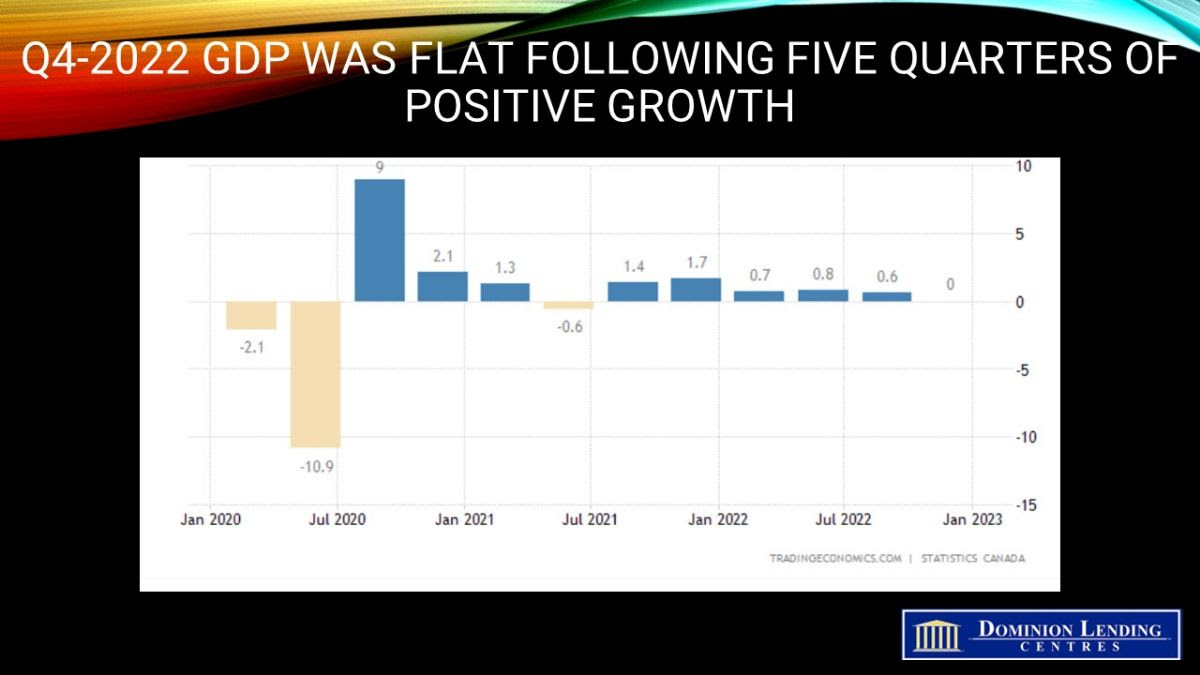
Statistics Canada released the real gross domestic product (GDP) figure for the final quarter of 2022 this morning, showing a marked slowdown in economic activity. This will undoubtedly keep the central bank on the sidelines when they announce their decision on March 8. The Bank had estimated the Q4 growth rate to be 1.3%. Instead, the economy was flat in Q4 at a 0.0% growth rate. This was the slowest quarterly growth pace since the second quarter of 2021.

Inventory accumulation in the fourth quarter declined for manufacturing and retail goods, driving investment in inventories to decline by $29.8 billion. Further, higher interest rates by the Bank of Canada hampered investment in housing (-8.8% at an annual rate), and business investment in machinery and equipment was a weak -5.5%. On the other hand, personal expenditure in the Canadian economy expanded by 2.0% (vs -0.4% in Q3), supported by the red-hot labour market. Government spending growth also accelerated. At the same time, net foreign demand contributed positively to GDP growth as exports grew by 0.8% while imports shrank by 12.0%.

The weak Q4 result reduced the full-year gain in GDP for 2022 to 3.4%, compared to 2.1% in the US, 4.0% in the UK, and 3.6% in the Euro area.

The January GDP flash estimate was +0.3%, pointing towards a rebound in the first quarter of this year. However, flash estimates are always volatile and subject to revision. Nevertheless, the growth in GDP this year will likely be much more moderate, less than 1%.

Bottom Line

The weakness in today’s economic data will be good news to the Bank of Canada, having promised a pause in rate hikes to assess the impact of the cumulative rise in interest rates over the past year. Today’s GDP report and the slowdown in the January CPI inflation numbers portend no interest rate hike on March 8.

Now the Bank will be looking for a softening in the labour market.

Dr. Sherry Cooper
Chief Economist, Dominion Lending Centres
drsherrycooper@dominionlending.ca
17 Feb

Canadian Housing Update with Dr Sherry Cooper

General

Posted by: Liz Fraser

December Housing Data Ended 2022 on a Weak Note
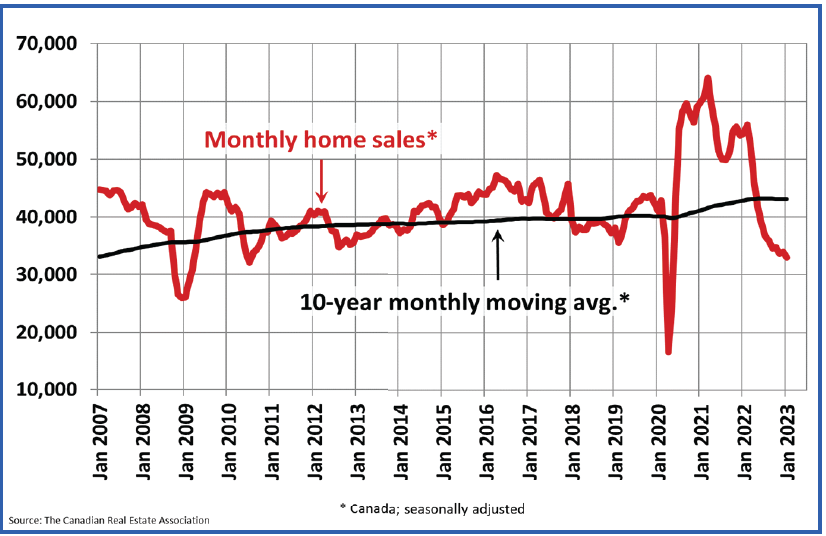
The Canadian Real Estate Association says home sales in January were the lowest for the month since 2009 and fell 37.1% from a year ago. The Canadian housing market has been sliding for eleven consecutive months as the unprecedented rise in interest rates–up from 25 basis points to 4.5% for the policy rate–has moved buyers to the sidelines. This is an abrupt reversal in the fevered pace of home sales during the pandemic.

The rapid rise in interest rates, designed to combat inflation, has driven many buyers to the sidelines. Higher borrowing costs have reduced affordability despite the sharp decline in prices in many regions.

On a regional basis, sales gains in Hamilton-Burlington and Quebec City were more than offset by declines in Greater Vancouver, Victoria and elsewhere on Vancouver Island, Calgary, Edmonton, and Montreal.

New Listings

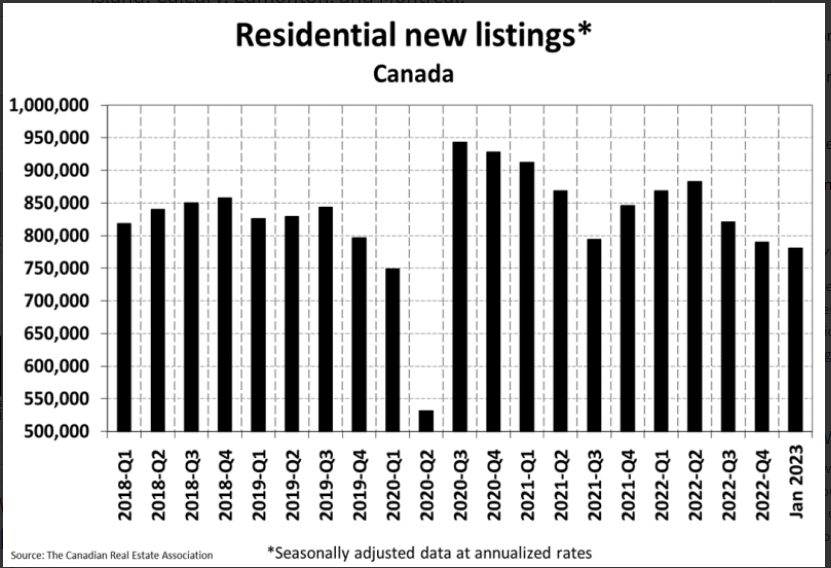
Last month, the number of newly listed homes rose 3.3% on a month-over-month basis, led by increases across British Columbia. Despite the slight increase, new listings remain historically low nationally. New supply in January 2023 hit the lowest level for that month since 2000.

With new listings up and sales down in January, sales-to-new listings eased back to 50.7%. This is roughly where it had been over the entire second half of 2022. The long-term average for this measure is 55.1%.

There were 4.3 months of inventory on a national basis at the end of January 2023. This is close to where this measure was in the months leading up to the initial COVID-19 pandemic lockdowns, considered historically slow.

Home Prices

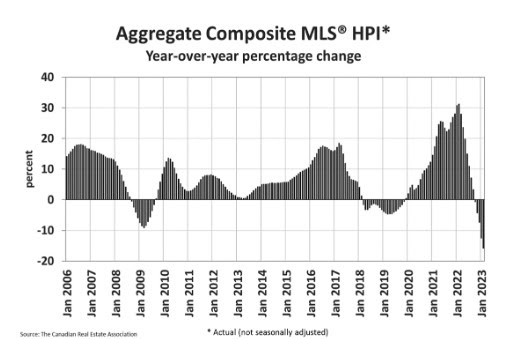
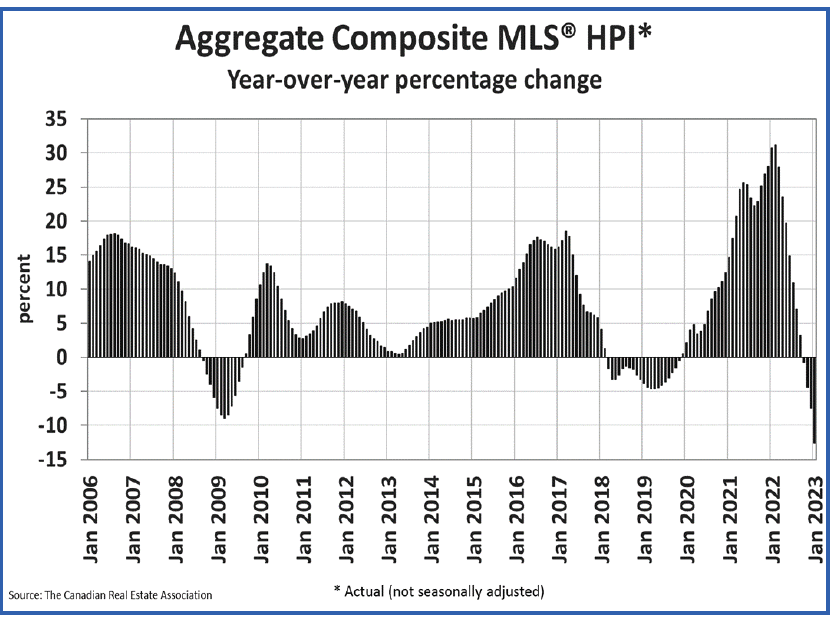
Canadian home prices fell by the most on record in 2022 as rapidly rising interest rates forced a market adjustment that is still ongoing.

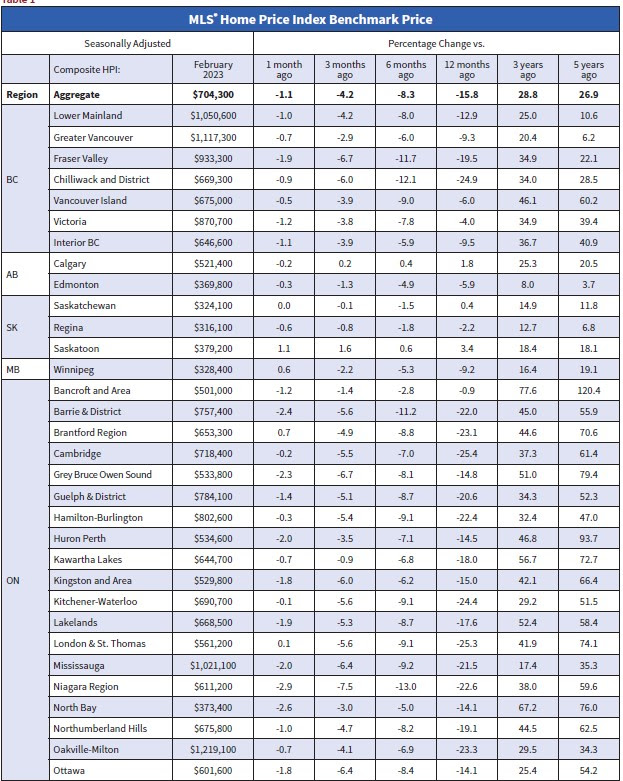
The Aggregate Composite MLS® HPI was 15% below its peak in February 2022. Looking across the country, prices are down from peak levels by more than they are nationally in many parts of Ontario and some parts of B.C. and down by less elsewhere. While prices have softened to some degree almost everywhere, Calgary, Regina, Saskatoon, and St. John’s stand out as markets where home prices are barely off their peaks at all.

In contrast, some East Coast markets have bottomed and appear to be trending higher.

Housing Construction Falls

In other news, CMHC reported that the annual pace of housing starts fell 13% in January. The national housing agency says the seasonally adjusted annual rate of housing starts for the year’s first month was 215,365 units compared with 248,296 in December.

This is very troubling as the population growth in Canada is slated to be very strong, and rental properties are in very short supply. The housing shortage will only rise. Rents have surged in many parts of the country for new inhabitants, straining household budgets even more.

With interest rates high and the cost of construction booming, many developers are moving to the sidelines.

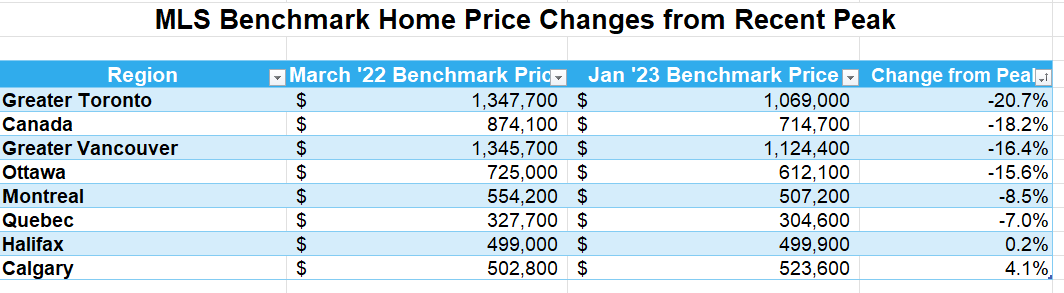
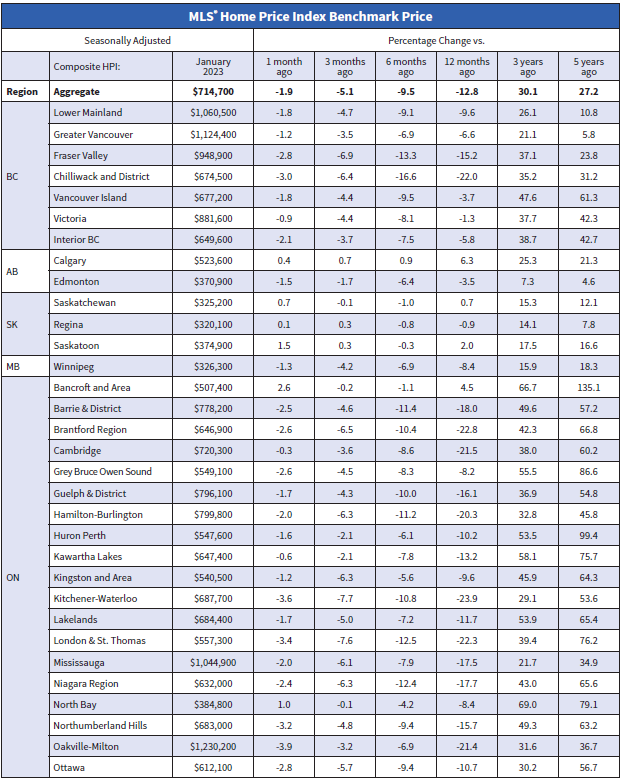
The table below shows the decline in MLS-HPI benchmark home prices in Canada and selected cities since prices peaked in March when the Bank of Canada began hiking interest rates. More details follow in the second table below. The most significant price dips are in the GTA and the GVA, where the price gains were spectacular during the Covid-shutdown.

Even with these large declines, prices remain roughly 33% above pre-pandemic levels.

Bottom Line

The Bank of Canada has promised to pause rate hikes assuming inflation continues to abate. We will not see any action in March. But the road to 2% inflation will be a bumpy one. I see no likelihood of rate cuts this year, and we might see further rate increases. Markets are pricing in additional tightening moves by the Fed.

There is no guarantee that interest rates in Canada have peaked. We will be closely monitoring the labour market and consumer spending.

Dr. Sherry Cooper
Chief Economist, Dominion Lending Centres
drsherrycooper@dominionlending.ca
13 Feb

Red Hot Labour Market Despite Rate Hikes by Dr Sherry Cooper

General

Posted by: Liz Fraser

Red Hot Labour Market Despite Rate Hikes
Today’s Labour Force Survey (LFS) for January was much stronger than expected, once again calling into question how long the Bank of Canada’s rate pause will last. This report showed no evidence that the labour market is slowing in response to the vast and rapid runup in interest rates.

Employment surged by 150,000–ten times more than expected–and most of the gain was in full-time jobs. The employment rate has returned to pre-pandemic levels. Employment rates among people 55 to 64 have been on a solid upward trend since the summer of 2022, mirroring the rise in employment over that period observed among most demographic groups.

Immigration remains a vital factor in hiring. According to the latest population estimates, in the third quarter of 2022, Canada’s population grew the fastest in over 50 years, mainly driven by an increase in non-permanent residents. In the Labour Force Survey, non-permanent residents represent the majority of a larger group, including those who were not born in Canada and have never been landed immigrants. Non-permanent residents can hold various kinds of work, study, or residence permits. On a year-over-year basis, employment for those not born in Canada and who have never been a landed immigrant was up 13.3% (+79,000) in January, compared with growth in total employment of 2.8% (+536,000).

Average hourly wages rose 4.5% on a year-over-year basis in January, down from 4.8% in December. This is good news for the inflation outlook, but it remains much above the 2% target. Year-over-year wage growth reached 5.0% in June 2022 and peaked at 5.8% in November (not seasonally adjusted).

The unemployment rate remained near a record low, holding steady at 5.0% in January, just shy of the record-low 4.9% in June and July last year.

Employment growth was most robust in wholesale and retail trade, healthcare, education, other services and construction.

Bottom Line

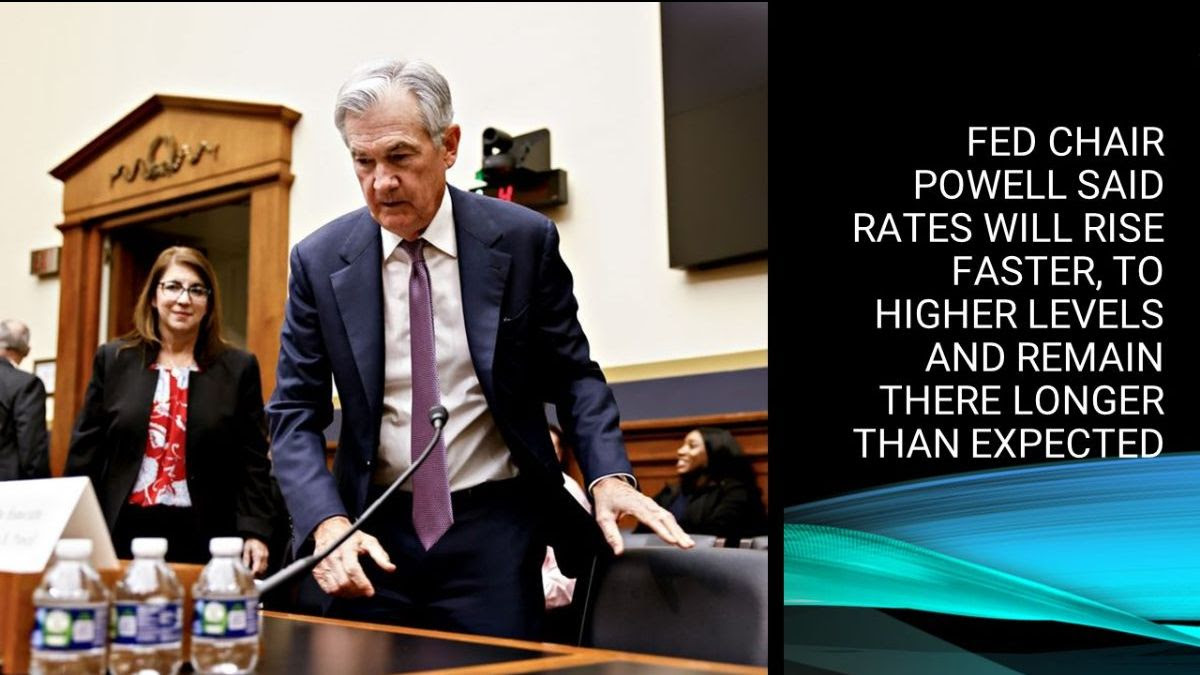
The Canadian jobs market is showing no signs of slowing. This has to make the Bank of Canada at least a bit nervous. The US jobs market data in January was also robust, and the Fed Chairman, Jay Powell, has assured markets that interest rates are likely to rise further.

This is the last jobs report before the Bank of Canada meets again on March 8. The CPI data for January will be released on February 21 and will be the primary factor determining Bank action. If inflation continues to decline, as expected, the rate pause will hold. If not…

Dr. Sherry Cooper
Chief Economist, Dominion Lending Centres
drsherrycooper@dominionlending.ca
26 Jan

No Surprises Here: The Bank of Canada Hiked Rates By Only 25 bps, Signaling a Pause by Dr Sherry Cooper

General

Posted by: Liz Fraser

No Surprises Here: The Bank of Canada Hiked Rates By Only 25 bps, Signaling a Pause
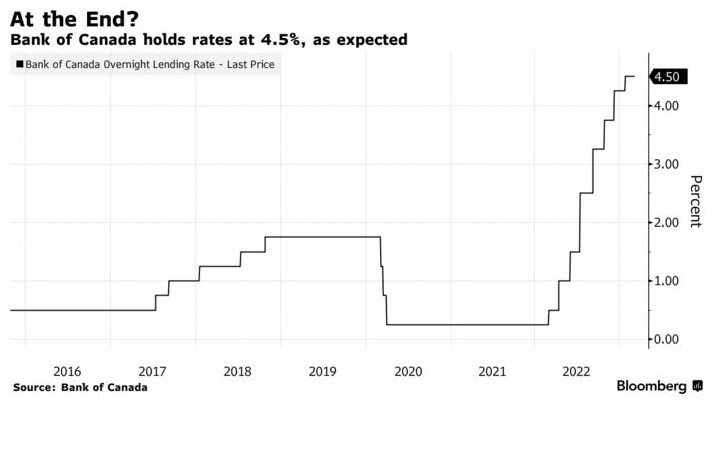
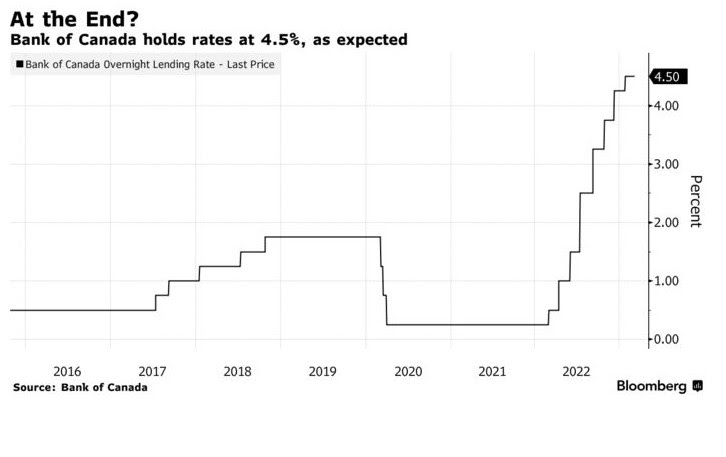
As expected, the Bank of Canada–satisfied with the sharp decline in recent inflation pressure–raised the policy rate by only 25 bps to 4.5%. Forecasting that inflation will return to roughly 3.0% later this year and to the target of 2% in 2024 is subject to considerable uncertainty.

The Bank acknowledges that recent economic growth in Canada has been stronger than expected, and the economy remains in excess demand. Labour markets are still tight, and the unemployment rate is at historic lows. “However, there is growing evidence that restrictive monetary policy is slowing activity, especially household spending. Consumption growth has moderated from the first half of 2022 and housing market activity has declined substantially. As the effects of interest rate increases continue to work through the economy, spending on consumer services and business investment is expected to slow. Meanwhile, weaker foreign demand will likely weigh on exports. This overall slowdown in activity will allow supply to catch up with demand.”

The report says, “Canada’s economy grew by 3.6% in 2022, slightly stronger than was projected in October. Growth is expected to stall through the middle of 2023, picking up later in the year. The Bank expects GDP growth of about 1% in 2023 and about 2% in 2024, little changed from the October outlook. This is consistent with the Bank’s expectation of a soft landing in the economy. Inflation has declined from 8.1% in June to 6.3% in December, reflecting lower gasoline prices and, more recently, moderating prices for durable goods.”

Short-term inflation expectations remain elevated. Year-over-year measures of core inflation are still around 5%, but 3-month measures of core inflation have come down, suggesting that core inflation has peaked.

The BoC says, “Inflation is projected to come down significantly this year. Lower energy prices, improvements in global supply conditions, and the effects of higher interest rates on demand are expected to bring CPI inflation down to around 3% in the middle of this year and back to the 2% target in 2024.” (the emphasis is mine.)

The Bank will continue its policy of quantitative tightening, another restrictive measure. The Governing Council expects to hold the policy rate at 4.5% while it assesses the cumulative impact of the eight rate hikes in the past year. They then say, “Governing Council is prepared to increase the policy rate further if needed to return inflation to the 2% target, and remains resolute in its commitment to restoring price stability for Canadians.”

Bottom Line

The Bank of Canada was the first major central bank to tighten this cycle, and now it is the first to announce a pause and assert they expect inflation to fall to 3% by mid-year and 2% in 2024.

No rate hike is likely on March 8 or April 12. This may lead many to believe that rates have peaked so buyers might tiptoe back into the housing market. This is not what the Bank of Canada would like to see. Hence OSFI might tighten the regulatory screws a bit when the April 14 comment period is over.

Dr. Sherry Cooper
Chief Economist, Dominion Lending Centres
drsherrycooper@dominionlending.ca
10 Jan

Employment Report Ended 2022 With A Boom by Dr Sherry Cooper

General

Posted by: Liz Fraser

Employment Report Ended 2022 With A Boom
Today’s Labour Force Survey for December was much stronger than expected, raising the odds of a 25 bps increase in the policy rate by the Bank of Canada on January 25th. While the Bank has hiked rates by 400 bps to 4.25%, core inflation remains sticky, wages have risen by more than 5% for the seventh consecutive month in December, and Q4 GDP is running well above the Bank’s forecast of 0.5%.

Employment rose by 104,000 last month, and the unemployment rate fell to 5.0%–just above the 50-year low of 4.9% posted in June and July. Indeed, the jobless rate would have fallen even further had the labour force participation rate not ticked upward as discouraged workers re-enter the jobs market when vacancies are plentiful. Employment rose the most for youth and people aged 55 and older.

Throughout 2022 the employment rate of core-aged women hovered around record highs. On average, 81.0% of core-aged women were employed, the highest annual rate since 1976 and 1.3 percentage points higher than in 2019.

Much of this increase has been among women with young children. On average, during 2022, 75.2% of core-aged women with at least one child under six years of age were working at a job or business, up 3.3 percentage points compared with 2019.

The increase in employment in December was driven by full-time work, which rose for a third consecutive month.  Full-time work also led employment growth for the year ending in December 2022.

Employment rose in multiple industries, notably construction, transportation, and warehousing.

Job gains were reported in Ontario, Alberta, BC, Manitoba, Newfoundland and Labrador, and Saskatchewan.  There was little change in the other provinces.

Bottom Line

The Canadian economy has also been boosted by strength in the US, where nonfarm payroll employment rose by 223,000 in December, and the unemployment rate fell to 3.5%, matching a five-decade low.

Governor Tiff Macklem and his officials have slowed down the rate hikes (from 75 bps to 50 bps) and signalled that future decisions would depend on economic data. Indeed, the most recent GDP and today’s jobs report point to continued economic strength. The October and November gains in GDP suggest Canada’s growth is holding up better than expected. The economy is on track to expand at an annualized rate of 1.2% in the fourth quarter, exceeding the central bank’s expectations.

The December CPI report will be released on Jan 17, ahead of the Jan 25 Bank of Canada decision. That will be closely watched as well.

In other news, housing market activity continued to slow in December. Home sales plummeted in the country’s largest metro areas by 30%-to-50% as buyers and sellers moved to the sidelines. Housing is the most interest-sensitive sector and has been slowing since the Bank began hiking interest rates last March.

Greater Vancouver led the way, with sales falling 52% year-over-year, while the Greater Toronto Area saw a 48% decline. Montreal followed with a 39% annual decline, whereas sales were down 30% in both Calgary and Ottawa.

Average prices continued to fall in most of the metro areas. The MLS Home Price Index benchmark is now down 9% year-over-year in the Greater Toronto Area. In Calgary, however, average prices remain nearly 8% above year-ago levels.

Dr. Sherry Cooper
Chief Economist, Dominion Lending Centres
drsherrycooper@dominionlending.ca
27 Dec

The Bank of Canada Won’t Like This Inflation Report by Dr Sherry Cooper

General

Posted by: Liz Fraser

The Bank of Canada Won’t Like This Inflation Report
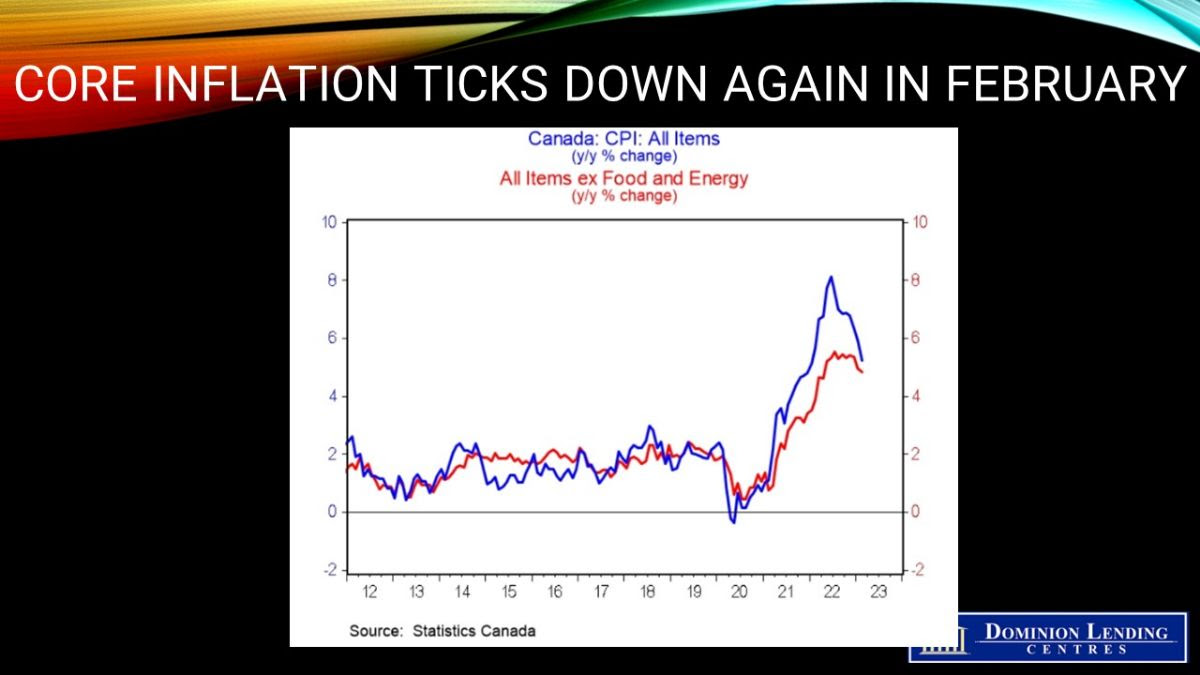
November’s CPI inflation rate fell only one tick to 6.8%, despite gasoline prices falling. This follows a two-month reading of 6.9%. Excluding food and energy, prices rose 5.4% yearly last month, up from 5.3% in October. Critical gauges of underlying price pressure were mixed but continued to creep higher. The all-important three-month trend in Core CPI edged to a 4.3% annualized rate from 4.0% the month before.

This is not good news and does nothing to assuage the central bank’s concerns about inflation. Price pressures remain stubbornly high, even as the economy slows and higher borrowing costs start to curb domestic demand.

Slower price growth for gasoline and furniture was partially offset by faster mortgage interest cost and rent growth. Headline inflation fell just one tick to 6.8% following two months at 6.9%, and core inflation remains sticky.

Digging into the still-strong core results revealed some new areas of concern. After years of helping hold back inflation, cellular services rose 2.0% y/yon “fewer promotions,” while rent took a big step up and is now at a 30-year high of 5.9% y/y (from 4.7% last month). Mortgage interest costs are another driving force, rising 14.5%, the most significant increase since February 1983. Just six months ago, they were still below year-ago levels. The transition from goods-led to services-driven inflation continues apace, with services prices up 5.8% y/y, or double the pace a year ago.

Prices for food purchased from stores rose 11.4% yearly, following an 11% gain in October.

Bottom Line

Before today’s report, traders were pricing in a pause at the next policy decision, with a possibility of a 25 basis-point hike. Barring an excellent inflation report for December, another rate hike is likely on January 25, likely a 25 bp hike. Given what’s happened in the first three weeks of this month, there is a good chance that the almost 14% drop in gasoline prices (compared to a 4% decline in December a year ago) could pull this month’s headline inflation down to 6.5%. However, many components of core inflation continue to rise.

While the BoC will slow the rate hikes in 2023, at least two or three more hikes are still possible, with no rate cuts likely next year. Remember, wage inflation is running at 5.6% y/y, and wage negotiations are getting more aggressive.

Dr. Sherry Cooper
Chief Economist, Dominion Lending Centres
drsherrycooper@dominionlending.ca
27 Dec

Canadian Housing Update by Dr Sherry Cooper

General

Posted by: Liz Fraser

Another Month, Another Dip in Housing
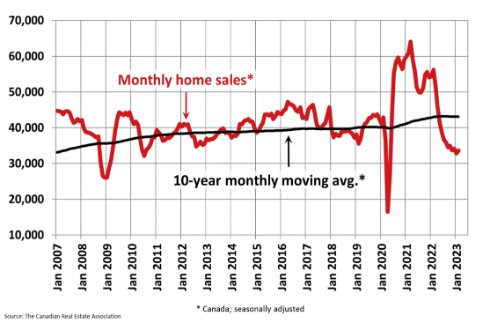
Statistics released today by the Canadian Real Estate Association (CREA) show home sales edged down in November. National home sales fell 3.3% between October and November, continuing the moderating sales trend that began last February on the precipice of unprecedented monetary policy tightening. Sales are down a whopping 39% from a year ago. The Bank of Canada has hiked their overnight policy rate by 400 bps, from 25 bps to 4.25%, triggering a whopping rise in mortgage rates.

About 60% of all local markets saw lower sales in November, led by Greater Vancouver and the Fraser Valley, Edmonton, the Greater Toronto Area (GTA) and Montreal.

The actual (not seasonally adjusted) number of transactions in November 2022 came in 38.9% below a near-record for that month last year. It stood about 13% below the pre-COVID-19 10-year average for November sales (see chart below).

New Listings

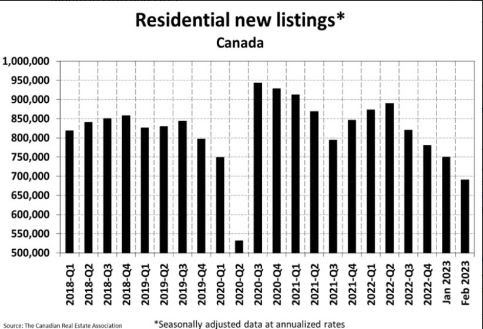
Sellers remain on the sidelines as the number of newly listed homes edged down last month by 1.3%, declining 6.1% from a year ago. Most sellers are waiting for interest rates to fall, either because they expect a rebound in sellers or are unwilling to buy new properties themselves with mortgage rates so high.

While sales have swung wildly, new listing flows have remained relatively steady through the recent turbulence and are very much in line with pre-COVID norms. There’s still not a lot of forced selling, which can exacerbate a price correction.

New listings fell in slightly more than half of the local markets. Among the larger markets in Canada, month-over-month movements in new supply were generally small, the only exception being some more significant declines in the B.C. Lower Mainland and Okanagan regions.

In terms of monthly new supply, the bigger picture is listings are not flooding the market. With the one exception of 2019, November 2022 saw the fewest new listings for that month in 17 years.

With sales down month-over-month by a little more than new listings in November, the sales-to-new listings ratio fell to 49.9% compared to 50.9% in October. The ratio has remained close to around 50% since May. The long-term average for this measure is 55.1%.

Based on a comparison of the current sales-to-new listings ratio with long-term averages, about 70% of local markets are currently in balanced market territory.

There were 4.2 months of inventory on a national basis at the end of November 2022. This is close to where this measure was in the months leading up to the initial COVID-19 lockdowns and still nearly a full month below its long-term average.

The Aggregate Composite MLS® Home Price Index (HPI) edged down 1.4% month-over-month in November 2022, continuing the trend that began in the spring.

The Aggregate Composite MLS® HPI now sits about 11.5% below its peak level. Breaking that down regionally, the general trend is prices are down somewhat more than they are nationally in Ontario and parts of B.C. and down by less elsewhere. While prices have softened to some degree almost everywhere, Calgary, Regina and Saskatoon stand out as markets where home prices are barely off their peaks at all.

The table below shows the decline in MLS-HPI benchmark home prices in Canada and selected cities since prices peaked in March when the Bank of Canada began hiking interest rates. More details follow in the second table below. The most significant price dips are in the GTA and the GVA, where the price gains were spectacular during the COVID-shutdown.
Bottom Line

OSFI announced this morning that the minimum qualifying rate for uninsured mortgages at federally regulated financial institutions would remain unchanged. They will review Guideline B-20 next month, but don’t hold your breath for an easing of the stress test.

In other news, housing starts were little changed last month at 264,600 annualized units. This is a strong level of new construction; the year-to-date average is roughly 265,000 units. Combined with the record 275,000 new units started last year, we are in line for the most significant two-year wave of housing starts on record. On a per-capita basis, we’re starting 2023 with an unprecedented construction boom despite higher costs, labour shortages and much higher interest rates.

Outlook   

The Bank of Canada is likely to raise the policy rate a couple of times by 25 bps in the first half of next year, pausing between rate hikes. They will not cut rates in 2023 even though the economy will post at least a mild contraction.

2024 will be a recovery year but don’t expect the overnight rate to return to the pre-Covid level of 1.75%. Indeed, the new cycle low will likely be more like 2.5% assuming inflation continues to trend downward. Price growth will be much more subdued than during the rocking ten-year period before the pandemic. Still, the underlying fundamentals of rapid population growth, mainly from immigration, bode well for sustained growth going forward.

Dr. Sherry Cooper
Chief Economist, Dominion Lending Centres
drsherrycooper@dominionlending.ca
27 Dec

The Bank of Canada Hiked Rates The Full 50 bps by Dr Sherry Cooper

General

Posted by: Liz Fraser

The Bank of Canada Hiked Rates The Full 50 bps
The Governing Council of the Bank of Canada raised its target for the overnight policy rate by 50 basis points today to 4.25% and signalled that the Council would “consider whether the policy interest rate needs to rise further to bring supply and demand back into balance and return inflation to target”. This is more dovish language than in earlier actions where they asserted that rates would need to rise further. Some have interpreted this new press release to imply that the Bank of Canada will now pause or pivot. I disagree.

I expect there will be additional rate hikes next year, but they will be more measured and not on every decision date. I also feel that the Bank will refrain from cutting the policy rate until 2024.

The Bank told us today that the “longer that consumers and businesses expect inflation to be above the target, the greater the risk that elevated inflation becomes entrenched”. CPI inflation remained at 6.9% in October, “with many of the goods and services Canadians regularly buy showing large price increases.

Measures of core inflation remain around 5%. Three-month rates of change in core inflation have come down, an early indicator that price pressures may be losing momentum. However, inflation is still too high, and short-term inflation expectations remain elevated”.

The economy remains in excess demand, and the labour market is very tight. The jobless rate in November fell to 5.1%, and job vacancies increased in September. Wage inflation came in at 5.6% y/y in November for the second consecutive month, marking six straight months of wage inflation above 5%. While headline and core inflation have moderated from their recent peaks, they exceed the 2% target by a large measure.

The Bank will monitor incoming data, especially regarding the overheated labour market where the jobless rate is at historic lows. Housing has slowed sharply in recent months, but as long as labour markets are tight, a slowdown in other sectors will be muted. The Bank now says it expects the economy “to stall” in the current quarter and the first half of next year.

Bottom Line

This will likely be the last oversized rate hike this cycle. The Governing Council next meets on January 25. Whether they raise rates will be data-dependent. If they do, it will likely be by 25 bps. Even if they pause at that meeting, it does not rule out additional moves later in the year if excess demand persists. I expect further monetary tightening, the continued bear market in equities, and a further correction in house prices.

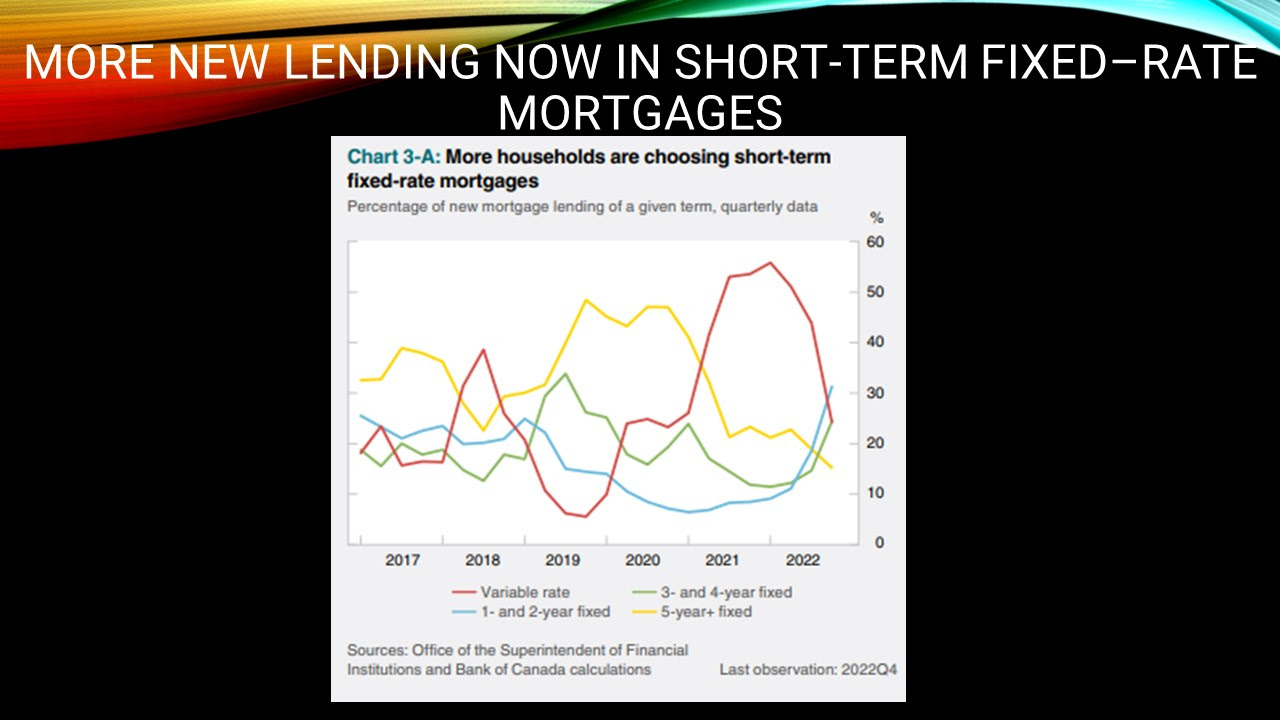
Canadian benchmark home prices are already down nearly 10% nationwide. Several chartered banks told us this week that more than 25% of the remaining amortizations for their residential mortgages are 35 years and more. At renewal, these institutions expect to grant mortgages amortized at 25 years, which implies a substantial rise in monthly payments. That may well be three or four years away, but clearly, many households could be pinched unless mortgage rates plunge in the interim. I do not see the policy rate falling to its pre-COVID level of 1.75% over that period because inflation back then was less than 2%, an improbable circumstance as we advance. Although supply constraints may be easing, globalization has peaked. Semiconductors produced in the US will not be as cheap, and many rents, prices, and wages will be very sticky.

Dr. Sherry Cooper
Chief Economist, Dominion Lending Centres
drsherrycooper@dominionlending.ca
5 Dec

New! Labour Force Report with Dr Sherry Cooper

General

Posted by: Liz Fraser

Little Comfort for the Bank of Canada in Today’s Jobs Report
Today’s Labour Force Survey for November will do little to assuage the Bank of Canada’s concern about inflation. While employment growth slowed to 10,100 net new jobs–down sharply from October’s reading–the report’s underlying details point to excess labour demand and rising wages. This is compounded by Monday’s data release showing that the Canadian economy grew by 2.9%, double the rate expected by the Bank of Canada. Everyone expects a slowdown in the current quarter and a modest contraction in the new year. However, excess demand is still running rampant in almost everything except housing.

Indicative of hiring strength, full-time employment was up a robust 50,700, and the private sector added 24,700 jobs. The jobless rate ticked down for the second consecutive month to 5.1%–well below the 5.7% rate posted immediately before the pandemic, which was considered full employment at that time. Total hours worked edged up, consistent with growth in the fourth quarter. And most notably, wage inflation came in at a year-over-year pace of 5.6% in November, the sixth consecutive month of greater than 5% wage inflation. Moreover, private and public sector unions demand even more significant wage gains as inflation remains close to 7%.

Businesses report difficulty filling jobs as job vacancies rose in the latest reading. The employment rate among core-aged women reached a new record high of 81.6% in November.
Employment rose in finance, insurance, real estate, rental and leasing, manufacturing, information, culture, and recreation. At the same time, it fell in several industries, including construction and wholesale and retail trade.

While employment increased in Quebec, it declined in five provinces, including Alberta and British Columbia.

Bottom Line

Today’s data are the last key input into the Bank of Canada’s December 7 interest rate decision. Overnight swap markets are fully pricing in a 25 basis-point hike next week, with traders putting about a one-third chance on a 50 basis-point move. Rising wages show no sign of cooling, and the economy posted much more robust growth in the third quarter than the Bank expected.

The overnight policy rate target is currently at 3.75%. If I were on the Bank’s Governing Council, I would vote for a 50-bps rise to 4.25%. Returning to a more typical 25 bps rise is premature, given inflation is a long way above the Bank’s 2% target. Inflation will not slow, with consumers and businesses expecting continued high inflation. Wage-price spiralling is a real risk until inflationary psychology can be broken.

In either case, additional rate hikes early next year are likely. Even when the central bank pauses, it will not pivot to rate cuts for an extended period. Market-driven longer-term interest rates have fallen significantly as market participants expect a recession in 2023. Fixed mortgage rates have fallen as well. The inverted yield curve will remain through much of 2023, with a housing recovery in 2024.

Dr. Sherry Cooper
Chief Economist, Dominion Lending Centres
drsherrycooper@dominionlending.ca
17 Nov

Canadian Inflation Update with Dr Sherry Cooper

General

Posted by: Liz Fraser

Bank of Canada Will Not Be Happy With This Inflation Report
Not only did the headline CPI inflation rate stall at 6.9% last month, but the core CPI numbers remain stubbornly high. Food inflation–a highly visible component–edged down slightly. Still, prices for food purchased from stores (+11.0%) continued to increase faster year over year than the all-items CPI for the eleventh consecutive month. Bonds fell on the news, with Canada’s two-year yield rising to 3.877% at 8:43 a.m. Ottawa time, about 3.5 basis points (bps) higher than its level before the data release. The yield on 5-year Government of Canada bonds spiked temporarily on the release of these disappointing inflation data. This was in direct contrast to the US, which posted a better-than-expected inflation reading for October last week.

Less than two weeks after a stronger-than-expected jobs report, the inflation numbers continue to show the economy in overheated territory. Bank of Canada Governor Tiff Macklem has said that rates will need to continue to rise further while acknowledging the end of this tightening cycle is near.

Traders are pricing at least a 25 basis-point increase at the next policy decision on Dec. 7, with a 50-50 chance of a half percentage point hike. The central bank has increased borrowing costs by 3.5 percentage points since March, bringing the benchmark overnight lending rate to 3.75%.

A significant factor in the Bank’s decision process is the continued rise in wage inflation to a 5.6% annual pace in October. If inflation expectations remain robust, wage-price spiralling becomes a real threat.

Bottom Line

Price pressures might have peaked, but today’s data release will not be welcome news for the Bank of Canada. There is no evidence that core inflation is moderating despite the housing and consumer spending slowdown. The average of the Bank’s favourite measure of core inflation remains stuck at 5.3%. The central bank slowed reduced its rate hike at the October 26th meeting to 50 bps, and while some traders are betting the hike in December will be 25 bps, there is at least an even chance that the Governing Council will opt for an overnight policy target of 4.25%.

Inflation is still way above the Bank’s 2%-target level. Ultimately, it will take a higher peak interest rate to break the back of inflation. I expect the policy target to peak at about 4.5% in early 2023 and to remain at that level for an extended period despite triggering a mild recession in early 2023.

Dr. Sherry Cooper
Chief Economist, Dominion Lending Centres
drsherrycooper@dominionlending.ca